 tacey
tacey Install on Shopify

On March 24, 2026, Shopify activated Agentic Storefronts for every eligible store by default. Orders are now flowing in from ChatGPT, Google AI Mode, Gemini, and Microsoft Copilot without any merchant action. AI-driven traffic to Shopify stores is up 7x since January 2025. AI-attributed orders are up 11x over the same period. Most articles cover discovery and product data, but not what happens after the order is placed.
That is the problem this article addresses. The gap between a customer paying through an AI channel and your warehouse touching the order is wider than most merchants realize. Agentic commerce just made this gap significantly harder to close. It creates a new class of order problems that existing tools were not built to solve.
How do agentic storefronts change Shopify orders?
Agentic commerce removes the customer's review of their shipping address at checkout. An AI agent submits the order programmatically using a stored address. This means the address has never been confirmed by a human in the context of the purchase, increasing the risk of errors and delivery failures.
Before agentic storefronts, almost every order passed through a checkout UI. The customer typed their address and had a moment to review it. Autocomplete might suggest corrections, and validators could flag issues. Agentic commerce removes that moment entirely. The AI agent sources the address from a user profile or previous order and submits it directly.
The order lands in your Shopify admin looking exactly like any other. It has a name, address, and payment confirmation, with a channel tag like ChatGPT. Nothing marks it as structurally different. But the address has never been reviewed by a human for this specific purchase. It was passed by an AI from a data source you cannot see.
At low volume, this is a manageable edge case. At the scale Shopify projects, with 880 million monthly ChatGPT users able to buy from any eligible store, this validation gap is a real operational problem. It will compound as every new AI channel activates.
Where do bad addresses in agentic orders come from?
Bad addresses in agentic orders come from AI agents using outdated or incorrect data. Unlike human typos at checkout, these errors stem from stale user profiles, data from other platforms, or default freight forwarder addresses. The source of the error is systemic, not a simple typo.
Bad addresses are not a new problem. The industry figure from Shippo puts the bad address rate at 2.1% of all e-commerce parcels. At 500 orders per month, that is about 10 bad orders. With carrier fees for address correction, this can become expensive quickly.
| Carrier | Address Correction Fee (2026) |
|---|---|
| FedEx | $25.50 per package |
| UPS | up to $25 per package |
These fees do not include support tickets, reshipment costs, or time spent managing customer complaints. What agentic commerce changes is the source of these errors. In a standard checkout, bad addresses come from human mistakes. In an agentic flow, the error sources are different in character.
- An AI agent may use an address from a user profile that has not been updated since the customer moved.
- An agent might pull an address from one platform while the customer's current address is stored on another.
- An agent could default to a freight forwarder for an international customer, hiding the final destination.
- The agent has no mechanism to prompt the user for confirmation, as speed is its primary value.
The industry's 2.1% bad address rate was measured on human-initiated checkouts. There is no equivalent figure for AI orders yet. However, the way AI agents source data suggests the rate is unlikely to be lower and may be meaningfully higher.
Can my checkout address validator app fix this?
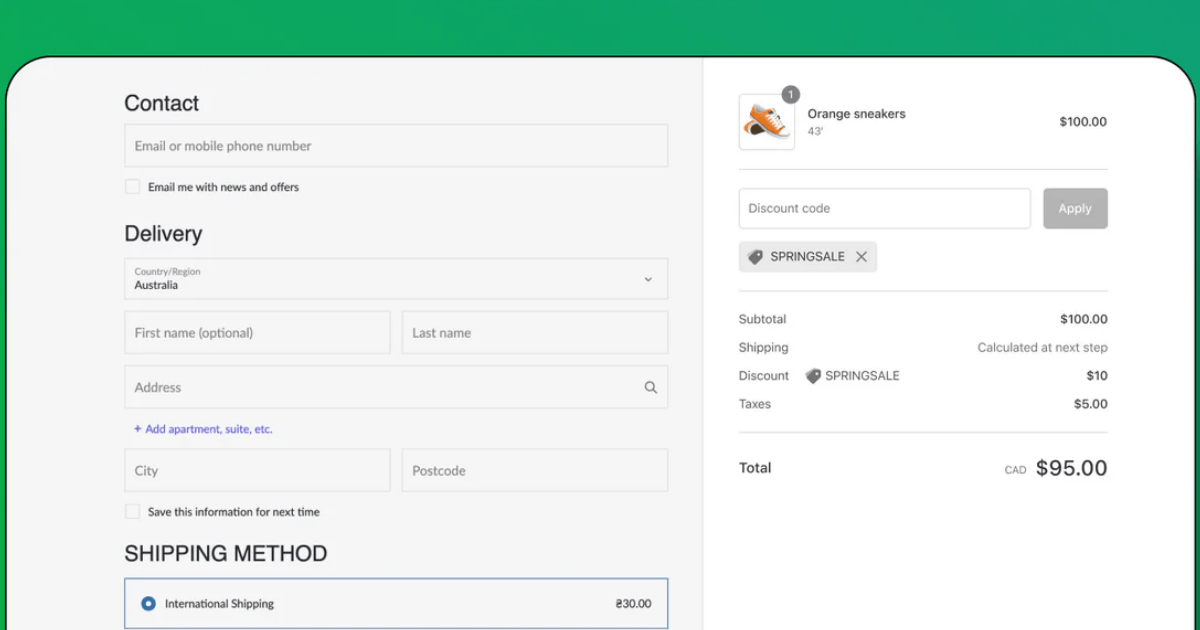
No. Checkout address validators work by adding prompts to the checkout user interface. Agentic commerce orders are placed programmatically via an API and bypass the checkout UI entirely. Your validator app never sees these orders, so it cannot correct them. This is an architectural limitation.
The standard advice has been to install a checkout validator. These apps check the address against a database and suggest corrections before payment. This approach already had limits, as customers could ignore suggestions. With agentic commerce, the tool has no opportunity to run at all.
This is not a gap that validator apps can close by updating their code. It is a reality of the architecture. Checkout validators are UI tools. AI agents transact at the API layer. Any tool that requires a human to interact with a form field cannot protect against what an AI agent does when it submits an order programmatically.
The same limitation applies to Shopify's own checkout address autocomplete feature. That tool helps customers type addresses correctly in a form. It has no surface to act on in an agentic purchase. Merchants who believe the address problem is solved are about to find that a growing part of their order volume is invisible to their tools.
How do agentic orders affect fraud detection?
Agentic orders lack the human behavioral signals that standard fraud detection relies on, such as browsing history or time on page. An AI-placed order can look technically clean but lack context, potentially leading to inaccurate risk scores. It creates new signal patterns that require different analysis.
Standard fraud detection on Shopify weights signals like how a customer moved through checkout or whether device fingerprints match known patterns. These are meaningful because they reflect human behavior. Agentic commerce flattens most of these signals. The transaction is submitted in seconds, looking more like a script than a person.
Shopify's built-in risk score may return a lower risk rating on an AI-placed order because its execution pattern is technically clean. Meanwhile, new signal combinations emerge that warrant review before fulfillment.
- Billing address mismatch: An AI agent might use an old billing address with a current shipping address. This is not necessarily fraud but requires attention.
- First-time buyer with high order value: An AI purchasing for a new customer has no history with your store, removing a key validation point.
- Freight forwarder shipping addresses: These have historically been a fraud signal on high-value orders, and AI agents may use them by default for international customers.
- Velocity clustering: An agent buying multiple items might submit several orders quickly, triggering duplicate order flags that mimic fraud patterns.
What changes is the frequency and context of these signals. As AI-agent purchases grow, fraud tools built for human behavior will need to adapt to orders where those signals are absent by design.
What is the 'order window' and why does it matter for agentic commerce?
The order window is the time between when a customer pays and when your warehouse begins fulfillment. Inside this window, you can fix order issues for free. Agentic commerce increases the number of orders with potential problems, making it crucial to use this window for validation before incurring high costs.
This window opens at payment and closes the moment a pick slip prints or a fulfillment service receives the job. Inside it, the order can be inspected, corrected, or cancelled. Outside that window, every problem costs more to solve.
- A carrier address correction fee is up to $25.50 (FedEx, 2026 rate).
- A failed first delivery attempt costs an average of $17.20 per attempt (Loqate).
- Return shipping and reprocessing can add another $8 to $15 per parcel.
- A chargeback for an undelivered order can cost $50 to $100 in fees.
A single bad order caught before the label prints costs nothing to resolve. The same order caught after two failed delivery attempts can cost between $60 and $150. Agentic commerce increases the volume of orders flowing through that window and changes their composition. The cost of not using the window is higher than ever.
How can I validate orders that bypass checkout?
Use a post-order validation system that operates at the order layer, after payment but before fulfillment. This approach works on every order, regardless of its source. It involves automated holds, contextual fraud logic, and customer self-service correction to resolve issues without slowing down operations.
The merchants thinking carefully about this are asking what their operations look like when a meaningful percentage of volume comes from these new channels. The practical steps are straightforward but require a change in how the order layer is managed.
Validating addresses post-order is structurally different from checkout validation. It does not require a UI or customer interaction at a form field. It works on every order, whether from a standard checkout, Shop Pay, TikTok Shop, or an AI agent like ChatGPT.
Applying fraud logic requires reasoning based on signal combinations, not a single risk score. It evaluates the order against contextual signals like billing/shipping mismatch or a freight forwarder address. When a problem is detected, the order is held automatically, and the customer is contacted to resolve it before fulfillment begins.
What data shows the scale of this problem?
AI-attributed orders on Shopify are up 11x since January 2025, and the channel is now open to 880 million ChatGPT users. With 2.1% of e-commerce parcels having bad addresses and correction fees up to $25.50 per package, the potential financial impact is significant and growing rapidly.
To understand the size of the operational gap, these figures are worth holding together:
- AI-attributed orders on Shopify are up 11x since January 2025 (Shopify).
- AI-driven traffic to Shopify stores is up 7x in the same period (Shopify).
- ChatGPT has 880 million monthly active users who can now purchase from eligible stores.
- 2.1% of all e-commerce parcels encounter address issues (Shippo).
- FedEx charges $25.50 per address correction in transit (FedEx 2026 rate card).
- UPS charges up to $25 per address correction (Reveel Group, 2025).
- 74% of companies report that bad address data causes up to 25% of their failed deliveries (Loqate).
- 60% of all order edits made in Shopify stores are address fixes.
The trajectory is clear. The tools most merchants rely on were built for a checkout-oriented world. The merchants who build a post-order validation layer will absorb the cost of this problem before it becomes visible. The ones who wait will find it in their carrier invoices and chargeback reports.
What should I ask about my current order process?
Ask if your tools can validate addresses on orders without a checkout UI, like those from AI agents. Question if your fraud detection works without behavioral data. Check if you can automatically hold bad orders before fulfillment and let customers fix issues themselves without manual intervention.
Before AI-sourced order volume grows, these are the questions worth answering about your operations:
- Does your current stack validate addresses on orders that arrive through channels with no checkout UI?
- Does your fraud detection rely on behavioural signals that AI-placed orders will not generate?
- Do you have an automated mechanism to hold a bad order before your warehouse touches it?
- Can you contact a customer and resolve an address problem before a label prints, without manual intervention?
Tacey works at the order layer, not the checkout layer. The moment an order is placed, whichever channel it came from, Tacey checks the shipping address and tags anything it can't confirm in your Shopify admin. The customer can then fix their own address on the order status page before the order ships, and a clean order passes through untouched.
Because Tacey operates at the order layer rather than the checkout layer, it sees every order that lands in Shopify, including the ones that came through ChatGPT this morning and the ones that will come through Copilot and Gemini as those channels scale. The channel does not matter. The order layer is always the same.
Install Tacey from the Shopify App Store and try it free for 14 days. Plans start at $29 a month and scale with order volume.
The merchants who get ahead of this now will not notice the problem. The ones who wait will find it on their carrier invoices in 90 days, at a rate that has been compounding since the day Agentic Storefronts went live.
Frequently asked questions
Why can't I just use a checkout address validator app?
Checkout validators only work on orders that go through the checkout user interface. Agentic commerce orders from AI like ChatGPT bypass this UI entirely, so the validator app never sees them and cannot check the address. This is an architectural limitation of any checkout-based tool.
What is the "order window"?
The order window is the period after a customer pays but before your warehouse starts fulfillment. During this time, you can inspect, correct, or hold an order for free. Once the window closes and the order enters fulfillment, fixing problems incurs costs like carrier fees.
How do AI agents cause bad addresses?
AI agents can cause bad addresses by using outdated information from a user's profile, pulling data from the wrong platform, or defaulting to a freight forwarder. These are not simple typos but systemic data issues that bypass standard checks because the AI does not prompt the user for confirmation.
How does agentic commerce affect fraud detection?
It removes the behavioral signals, like browsing time, that many fraud systems rely on. An AI-placed order is submitted programmatically, which can look unusual but is not necessarily fraudulent. This requires a shift to analyzing other signal combinations rather than relying on behavioral data.
What is post-order validation?
Post-order validation is the process of checking orders for issues after payment is complete but before fulfillment begins. It operates on the order layer, not the checkout layer, so it can catch problems from any sales channel, including agentic storefronts, standard checkout, and social commerce.
How much do bad addresses cost?
A bad address can be expensive. For example, FedEx charges $25.50 for an in-transit correction, and UPS charges up to $25. These fees are in addition to costs for support time, reshipment, and potential chargebacks if the delivery fails completely.
Are agentic orders marked differently in Shopify?
No, not in a way that flags them for review. They land in your Shopify admin looking like any other order, with a channel attribution tag like "ChatGPT" or "Google AI Mode". Nothing marks them as structurally different or having a potentially unverified address that needs checking.
 Install on Shopify