 tacey
 Install on Shopify
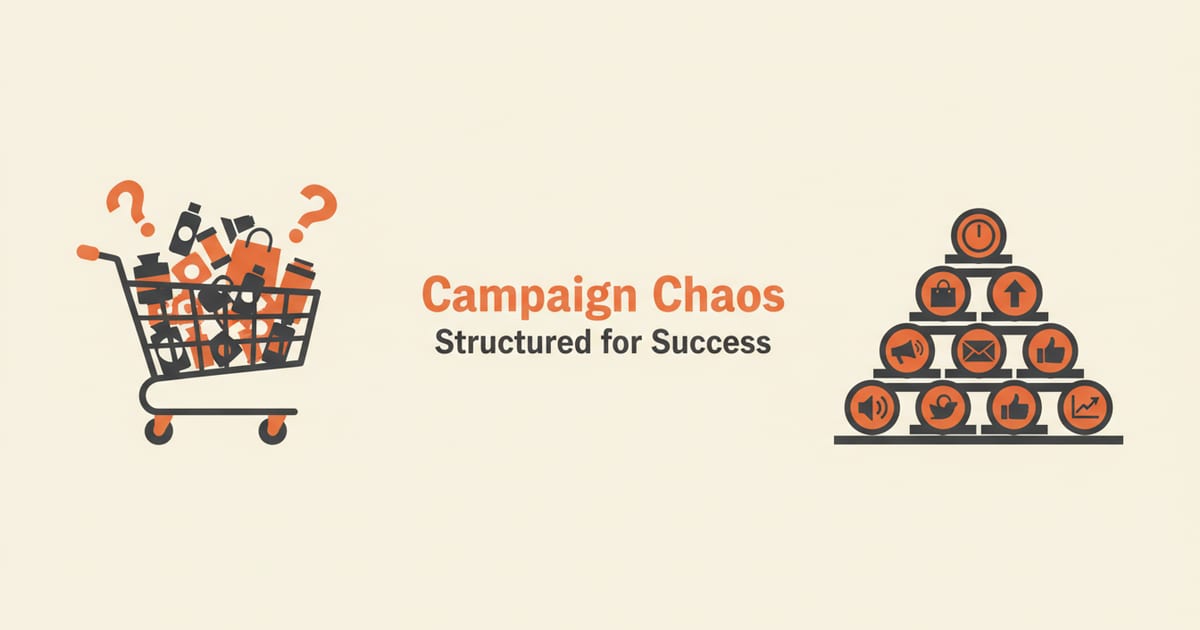
An effective Google Ads structure does more than just spend your budget; it brings qualified buyers to your Shopify store. The wrong structure wastes money on clicks that never convert, while the right one acts as a profit multiplier. For 2026, the ideal setup is a balanced portfolio of campaign types, each with a specific job.
What is a Google Ads campaign structure?
A campaign structure is how you organize your advertising efforts within Google Ads. It dictates how you allocate your budget, who you target, and what messages they see. Think of it as the blueprint for your entire advertising house. A solid structure separates different goals into different campaigns, preventing them from competing with each other.
A poor structure is like having the plumbing and electrical wiring drawn on the same page of the blueprint. A contractor cannot tell them apart. In Google Ads, this means your campaign for cheap, high-volume accessories is mixed with your campaign for expensive, low-volume furniture. The result is chaos.
The cheap clicks will always eat the budget first. Your ads for $10 phone cases get thousands of impressions, while your $1,500 sofa is never shown to a qualified buyer. This is the cost of a flat structure: your most profitable products become invisible, starved of budget by less important items.
Without a deliberate structure, merchants often end up with a single, massive campaign trying to do everything at once. This makes it impossible to see what is actually working. A clear structure allows you to assign specific budgets to specific goals, such as acquiring new customers or defending your brand name from competitors.
This organization is not just for tidiness. It is the foundation of control. By separating campaigns, you can set different bids for high-value products, target distinct audiences, and measure the return on ad spend (ROAS) for each part of your strategy accurately. It turns a chaotic expense into a predictable growth engine.
Why is the default Shopify Google app setup not enough?
The native Google & YouTube app on Shopify is a fantastic starting point for getting your products listed. It syncs your product feed and makes it possible to run ads quickly. However, its default settings often consolidate everything into a single Performance Max campaign, which limits your control and strategic depth.
This "all-in-one" approach turns your ad account into a black box. Money goes in, and some sales come out, but you have no visibility into the "why." You cannot learn which search terms, products, or audiences are driving growth. This makes strategic decisions impossible because you are flying blind.
A sophisticated advertiser needs more than the single asset group the default setup provides. You should create separate asset groups for different product categories, each with its own tailored images, videos, and copy. This gives Google's AI better signals to work with, leading to more relevant ad placements.
Relying solely on this default can obscure valuable data. You cannot easily see which specific products or search terms are driving sales, nor can you allocate budget with precision. It treats all products and all customers as if they have the same value, which is rarely the case for a growing store.
Scaling a Shopify store requires more granular control. You need the ability to push budget toward your most profitable products and pull back from losers. A dedicated campaign structure gives you the levers to do this. The default setup is built for ease of launch, not for long-term, profitable scaling.
How should I allocate my budget in 2026?
A resilient ad strategy depends on a balanced budget, not a single winning campaign. The key is to think of your budget as a portfolio, with different campaign types assigned to different jobs across the customer journey. This diversification of effort reduces your dependency on any one ad format and creates a more stable foundation for growth.
Rather than relying on a rigid percentage split, think in terms of priority and role. Your budget should be allocated based on a hierarchy of control, intent, and scale. This strategic approach provides a strong starting point for most ecommerce brands, allowing for adjustment as you gather performance data.
- Standard Shopping: The foundation for controlled, product-level advertising. This campaign type should command the largest share of your budget.
- Performance Max (PMax): The engine for scale and new customer discovery. This deserves a significant, but secondary, allocation.
- Non-Brand Search: The tool for capturing high-intent, active demand. This requires a dedicated portion of your budget to attract new buyers.
- Brand Defense: The essential insurance policy. This needs a smaller, but non-negotiable, investment to protect your traffic.
A Worked Example: A $5,000 Monthly Budget
Let's make this concrete. Imagine your Shopify store has a monthly ad budget of $5,000. Instead of applying a fixed formula, your allocation is a series of strategic decisions based on the roles of each campaign. This is not a rigid rule, but a framework for thinking about a typical ecommerce business ready to grow.
Start with the essentials. Your Brand Defense campaign is the first priority; allocate enough to ensure you always own the top ad spot for your own name. This might only be a small fraction of your budget. Next, fund your workhorse: Standard Shopping. This is where you will invest the most to drive predictable sales from your core products.
With the remainder of your budget, you will balance two competing goals. A dedicated portion must go to Non-brand Search to capture the active demand of shoppers who are looking for your products right now. The rest can then be used to fuel Performance Max, your engine for exploring new audiences and scaling your reach across Google's network.
This highlights a key trade-off: the new versus the established brand. A brand-new store might have zero searches for its name, making a Brand Defense campaign unnecessary at first. That budget could be moved to Non-Brand Search to build initial awareness and capture early interest.
Conversely, an older brand under attack from competitors might need to increase brand defense spending significantly. This might mean pulling funds from a less-critical campaign, like PMax, on a temporary basis to protect their core customer base from being poached at the final step of their journey.
This structure ensures you are capturing existing demand with Search, creating new demand with Shopping and PMax, and protecting your most valuable asset with a brand campaign. Each component has a distinct role, and together they form a comprehensive system for acquiring customers.
How does a Standard Shopping campaign fit in?
A Standard Shopping campaign is your workhorse for product-level control. This is where you allocate the largest portion of your budget because it offers the most transparency and direct management. Unlike PMax, Standard Shopping lets you see exactly which products are getting clicks and sales, and you can adjust bids for individual items or groups.
A concrete step is to use custom labels in your Shopify product feed. You can create labels like "high-margin," "bestseller," or "seasonal." In Google Ads, you can then subdivide your Standard Shopping campaign by these labels. This lets you set higher bids specifically for your most valuable products.
This control is vital for edge cases. A product might sell well but also have a high return rate, making it less profitable than it appears. PMax might see only the initial sale and push it hard. With Standard Shopping, you can spot the low net profit and reduce the bid, protecting your margins.
Use this campaign type for your core products and bestsellers. Because you have SKU-level control, you can push your most profitable items harder. You can also use negative keywords to filter out irrelevant search traffic, something that is more difficult with other campaign types. This makes your ad spend more precise and efficient.
This campaign is also a powerful tool for data collection. The performance data you gather here, such as which products have the highest click-through rates, can inform your broader marketing strategy. It tells you what customers are most interested in, providing insights you can use across your entire business.
When should I use Performance Max (PMax)?
Performance Max (PMax) campaigns are designed for reach and discovery. They use Google's machine learning to find new customers across all of Google's channels, including YouTube, Display, Search, and Shopping. This is the campaign type you use to scale your brand and reach audiences you might not have found otherwise.
The machine is only as smart as the data you feed it. Your most important inputs are audience signals. These are lists you provide to guide the campaign, such as your existing customer list, visitors who viewed a specific product, or users who abandoned a cart. Strong signals lead to strong results.
This is the classic "Control versus Scale" trade-off. Standard Shopping and Search offer precise control. PMax offers enormous scale. Using only PMax means giving up the control needed for efficiency. Using only Standard campaigns limits your reach. A balanced structure uses both for what they do best.
PMax works best when you provide it with strong creative assets, including images, videos, and compelling ad copy. It uses these assets to create ads for different formats and placements. While it offers less direct control than Standard Shopping, its strength lies in its ability to automate targeting and bidding to find conversion opportunities at scale.
Think of PMax as your exploratory force. It complements the surgical precision of your Standard Shopping and Search campaigns. It finds new pockets of customers, and you can then use insights from its performance to refine your other campaigns. It is a key part of a modern, balanced strategy.
What is the role of non-brand Search campaigns?
Non-brand Search campaigns capture customers who are actively looking for a product you sell, but do not know your brand name yet. They are searching for terms like "wool running socks" or "leather crossbody bag." These campaigns are crucial for attracting new customers at the moment they are expressing high purchase intent.
For example, a store selling socks should not have one ad group for all socks. Create one for "wool running socks" and another for "novelty cotton socks." The wool sock ad can promise warmth and performance, while the novelty sock ad can highlight fun designs. This relevance wins the click.
Getting this wrong is expensive. If you lump all keywords together, a search for "warm wool socks" might see a generic ad for "Fun Socks Here." The user will not click because the ad is not relevant. Your Quality Score drops, Google charges you more per click, and your competitor wins the customer.
Success here depends on tight keyword grouping and relevant ad copy. You should have separate ad groups for each category of product you sell. This allows you to match your ads and landing pages directly to the user's search query, which improves your Quality Score and lowers your cost per click.
This campaign type is a primary driver of new customer acquisition. While shoppers clicking on these ads may have never heard of you, they have a problem that your product solves. Winning that click is the first step in building a new customer relationship and is a fundamental part of growing your store beyond your existing audience.
Why do I need a brand defense campaign?
A brand defense campaign targets searches for your own brand name. It may seem unnecessary to pay for clicks from people who are already looking for you, but it is a critical and inexpensive form of insurance. Competitors can, and often will, bid on your brand name to steal your customers at the last moment.
The first click a customer makes should always be yours. Defending your brand name is not a cost; it is the foundation of owning your own traffic.
An important edge case is when your brand name is also a generic phrase. If your store is called "Fine Leather Wallets," bidding on your brand name becomes difficult. It will attract shoppers looking for any fine leather wallet, not just yours. This requires a more complex strategy using exact match keywords and negative keywords.
You can check if this is happening to you right now. Open a private or incognito browser window and search for your brand name. See which competitors, if any, appear in the ad slots above your organic listing. Do not click their ads, but make a note of who is trying to poach your traffic.
Running a campaign for your own brand name ensures you control the message and the destination. It allows you to appear at the top of the search results, directing customers to the exact page you want them to see. Clicks on brand terms are typically much cheaper than non-brand terms, making this a highly cost-effective strategy for protecting your traffic.
Without a brand campaign, you leave the top of the search results open to competitors or aggregator sites. This can create confusion and siphon off sales that should have been yours. A small investment in a brand campaign secures your most valuable traffic and provides a stable baseline of conversions.
How does this structure make my ad spend more efficient?
This balanced campaign structure turns your ad spend from a simple expense into a strategic investment. By separating your goals, you get a clear picture of what is working and can allocate your budget accordingly. You are not just throwing money at Google; you are methodically acquiring customers and can measure the cost of that acquisition.
The impact on profitability illustrates this. A target ROAS of 4:1 means you expect $4 in revenue for every $1 in ad spend, but this ratio ignores post-acquisition costs. If a customer places a second small order for an item they forgot, the cost of that extra shipment can erase the profit from your initial ad spend entirely. Preventing that second shipment by consolidating the items into the first order has a direct, positive impact on your true return.
This creates a powerful growth flywheel. A higher net profit from each conversion allows you to reinvest in your ad budget, enabling more aggressive bids or wider audience reach. Acquiring more customers through this efficient engine, and then maximizing the value of each order with post-purchase additions, creates a cycle of profitable growth.
Every customer you acquire through this carefully managed funnel has a cost. The goal is to make sure the lifetime value (LTV) of that customer is significantly higher than the acquisition cost. A strong ad structure gets the customer in the door. The next step is to maximize the value of that single, paid-for visit.
This is where post-purchase optimization becomes critical. Once a customer has completed their purchase, you have a unique opportunity to improve the efficiency of that transaction. Tools that operate on the order status page, like post-purchase upsells, allow customers to add items to their existing order without friction. This makes your initial ad spend more profitable by consolidating what might have been two separate shipments into one, boosting the net profit from the sale by saving on fulfillment and shipping costs.
Ultimately, a smart Google Ads structure is the first half of a complete customer acquisition strategy. It efficiently brings new buyers to your store. The second half is ensuring you capture the most possible value from that new relationship, turning a single transaction into a profitable, long-term customer.
Frequently asked questions
Do I need all four campaign types to start?
If you are on a limited budget, start with Standard Shopping and a Brand Defense campaign. These two will capture existing demand and protect your name. You can add Non-Brand Search and Performance Max as you gather data and have more budget to scale.
Can I run Standard Shopping and Performance Max at the same time?
Yes, and you should. PMax will typically take priority for serving ads if the user is eligible for both. However, having both allows you to maintain product-level control with Standard Shopping while using PMax for broader reach and discovery across Google's network.
What is a good Return on Ad Spend (ROAS) for Shopify?
A good ROAS can vary widely by industry and profit margin. A common benchmark to aim for is a 4:1 ratio, meaning you generate $4 in revenue for every $1 spent on ads. However, some brands may be profitable at 3:1, while others may need 5:1 or higher.
How long does it take for Google Ads to become profitable?
Expect a learning period of 30 to 90 days. During this time, Google's algorithms are gathering data to optimize your campaigns, and you are learning what works for your audience. Profitability is rarely instant and requires patience and consistent optimization.
Should I use "feed-only" Performance Max campaigns?
Feed-only PMax campaigns, which do not use creative assets and only run on Shopping inventory, can be a good strategy for merchants who want more control. It essentially turns PMax into a more advanced version of Smart Shopping, but this requires a more advanced setup and is not a beginner tactic.
How often should I adjust my campaign structure?
You should review your campaign performance weekly, but avoid making drastic changes to the structure too frequently. Give your campaigns time to gather data. You might adjust the core structure quarterly or semi-annually based on major shifts in performance or business goals.
What is the most common mistake with Google Ads for Shopify?
The most common mistake is setting up a single campaign and letting it run without any segmentation. This leads to wasted spend and a lack of actionable insights. A structured, multi-campaign approach is fundamental to long-term success.
 Install on Shopify