 tacey
 Install on Shopify

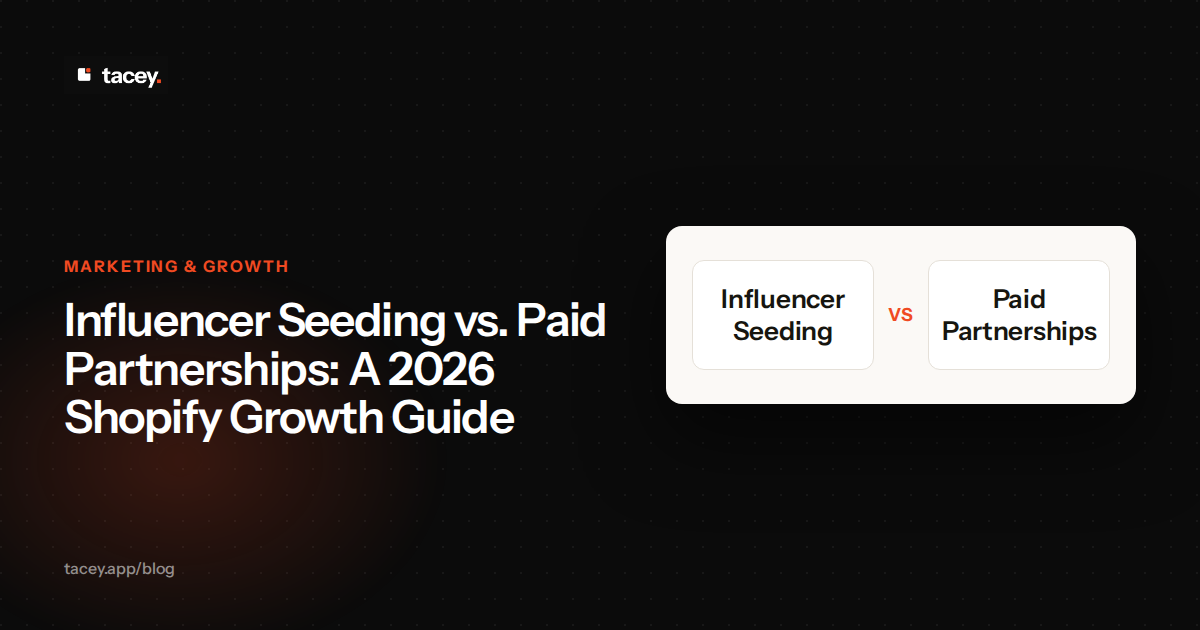
Shopify influencer seeding means sending free product to creators so they try it and, if they like it, talk about it. A paid partnership means you pay a creator a fee, product or both, in exchange for content that follows an agreed brief. The two can reach the same audience, but they cost different amounts and ask different things of your store.
This guide explains how each one works, where each one fails, and how to choose based on your stage and budget. It also covers a part most guides skip: what happens after a creator's audience turns into a real order, and why the shipping address on that order matters as much as the post. For most new stores, the honest starting point is seeding, kept small, with paid work added only after you can see which creators sell.
What is influencer seeding and how does it work?
Influencer seeding is sending free product to creators with no contract and no required post. The creator decides whether to share it, and the brand's cost is the product and the postage. Nothing is owed in return, so the arrangement depends on the product and the relationship rather than on a deal.
The mechanism is simple. You pick creators whose audience matches the buyer you want, send them an item, and let the product do the work if it earns a post. Nobody is paid for the post itself, so the creator's reason to share is the product and whatever goodwill comes from receiving a gift from a brand they already like.
Seeding works best when the product is easy to show. A skincare set, a kitchen tool or a piece of clothing gives a creator something to film in a few seconds. A product that needs a long explanation is harder to share without a paid brief that walks the creator through it.
Seeding also has a limit you should name before you start. Because nothing is owed, nothing is guaranteed. Many creators will receive the box and never post about it. That outcome is part of the plan, not proof that the campaign failed.
What is the difference between seeding and a paid influencer campaign?
Seeding trades free product for a chance at organic content, while a paid partnership buys a set deliverable on a set date. Seeding has no guaranteed post. A paid deal has a written agreement that says what gets posted, when, and how the content can be reused.
The difference shows up in five places: what the brand pays, what the creator owes, how much control the brand keeps over the message, how predictable the timing is, and how easy the results are to trace. The table below sets the two side by side.
| Factor | Seeding | Paid partnership |
|---|---|---|
| What the brand pays | Product and shipping | A fee, product, or both |
| What the creator owes | Nothing in writing | The posts and deliverables in the agreed brief |
| When content appears | Whenever the creator chooses, if at all | On the date in the agreement |
| Brand control over the message | Low, because the creator uses their own voice | Higher, through the brief, approvals and usage terms |
| Ease of tracking | Harder, and it needs a unique code or link | Easier, because deliverables are agreed up front |
| Best fit | Early stage, testing product fit | A product that already sells, with a clear offer |
Neither option is better in general. Seeding gives you low-cost reach and honest reactions from people who chose to talk about the product. A paid partnership gives you predictable content and control, which costs more and needs a store that can handle the demand a post creates.
Read the table as a trade-off, not a ranking. The cheaper option costs you predictability. The predictable option costs you the cash to buy it, and it only pays off when the product is ready to sell.
Which strategy is better for a new Shopify store with a small budget?
For a new store with little cash, seeding is usually the better start, because it lets you test product fit before you commit fees. Move to paid work once a product has sold through organic posts and you know which creators' followers buy.
A new store has two problems. It does not yet know which product sells, and it does not have enough orders to measure what a creator adds. Seeding helps with the first problem because it puts the product in front of many people for little more than the cost of the goods and the postage.
Paid partnerships solve a different problem. They make sense when you already know a product converts and you want a creator to push it on a schedule. Paying before you know that is how a small budget ends up in one campaign that produces no sales you can point to.
A sensible small-budget sequence runs seeding first, watches which products get shared, and tracks which creators' followers buy. Then you spend on the one or two creators who showed results. The trade-off is time, because seeding takes weeks of outreach and follow-up before much shows up. A store that needs sales this month may find that too slow, and a small, clearly measured paid test becomes the honest choice.
How do I find the right influencers to send my product to?
Look for creators whose audience already resembles your buyer, and whose recent posts show the kind of product you sell. Audience size matters less than fit, because a smaller audience that buys is worth more than a large one that only watches.
Start with the buyer, not the creator. Write down who buys your product, what they already follow, and what they would ask a friend before buying. Then search the platforms where that buyer spends time and read the last several posts from each candidate before you add them to a list.
Check for signs that the audience responds, not only that the account looks large. Comments that ask about the product, past brand posts that look natural rather than scripted, and no recent work with a direct competitor are all useful signals. Each one tells you something about how the next post will land.
Keep the first list short. A small set of carefully chosen creators teaches you more than a long list pulled from a directory, because you can follow each one closely and compare what happens. When you reach out, say what you are sending and why you picked that creator, in two or three specific sentences. Creators receive many generic pitches, so the specific reason is the part they read.
What should I include in a product seeding package?
A seeding package should hold the product, a short note that asks for nothing, and a unique code or link you can track. Keep it plain, and make the box easy to open. A package that looks expensive matters less than one that is clear about what it is.
Start with the product itself, in the version a customer would receive. A special pre-release item or an unfinished sample can produce a post about something your buyers cannot get. If you do send something exclusive, say so in the note, so the creator does not promise a product that customers will not find.
The note matters more than most merchants expect. Write one short paragraph that says who you are, why you chose this creator, and that there is no obligation to post. Asking for a post inside the note turns a gift into an unwritten contract, and creators notice when the terms were never stated.
Add a unique discount code or link to the note so you can see which creator drove a sale. This is a tracking tool, not a bonus for posting, and it works best when the code is simple to type. Before the box leaves, confirm the shipping address. Ask the creator to reply with an address rather than trusting an old profile, and check the unit number. A wrong address on a gift costs you twice, once for the postage and once for the delay.
How do I track the results of a seeding campaign?
Track each creator with a unique code or link, then count the sales, saved posts and replies you can trace back to that creator. Compare creators against each other, not against a total you cannot split. A code that only counts people who typed it will undercount, but it undercounts every creator in the same way.
Seeding is hard to measure because a post can appear days or weeks after the box arrives, and many buyers never click anything. A creator's post might reach someone who buys later from a search, and no code will show that. The code is still the cleanest signal you have, so use it for every creator, every time.
Keep a simple log. Record the creator, the product sent, the date it shipped, the date the post appeared, and the orders tied to each code. A spreadsheet is enough for your first few campaigns. The point is to see the same fields for every creator, so the comparison is fair.
Decide before you start whether awareness counts as a result. A creator whose post gets attention but no code use may still help your brand. If you decide this in advance, you will not judge the whole campaign by the one number you wanted. Then give each campaign a fixed window, often several weeks after the last box lands, before you decide anything. Late results are common in seeding, and cutting a creator too early throws away the signal you were trying to collect.
When does it make sense to move from seeding to paid partnerships?
Move to paid partnerships when a product has already sold through organic posts and you can name the creators who sent buyers. Paying for a post should follow proof of demand, not come before it. A paid brief can scale something that works, but it rarely creates demand from nothing.
The signal to watch is repeatable results. One viral post can come from luck, and luck does not scale. When several creators in different niches produce orders, the product is probably doing the work, and that is the point where a brief and a fee can make sense.
A creator who receives the wrong box has already formed a first impression, and no discount code repairs that.
Paid work also brings obligations. You need a brief, clear usage terms for how you can reuse the content, and a plan for the traffic a post will send. A post that sends a sudden wave of visitors to a slow checkout or an out-of-stock page wastes the money. Check that the store is ready before the post goes live.
Usage rights are the part many first-time brands miss. Ask what the agreement allows you to reuse in ads or on your own site, and whether that costs extra. Settle this before you sign, because it is much harder to add later.
What are the typical costs for paid influencer posts in 2026?
Paid influencer costs vary by creator size, platform, how many deliverables you buy, and whether you also pay for usage rights. There is no single going rate, so ask each creator or agency for a written quote that lists exactly what you get. Any price without that detail is not comparable to another price.
Price usually follows audience size, but not in a straight line. A creator with a small, engaged audience in a tight niche can cost less per buyer than a large account with broad followers. The price also rises when you ask for more than one post, a video, a story, or a license to reuse the content in paid ads.
Ask for the terms in writing. A quote should name the platform, the number of posts, the format, the posting date, how long the post stays live, and whether you can run it as an ad. Two quotes that look similar can differ a lot once usage rights are added to one and left out of the other.
Compare the cost to the orders you can trace, not to the follower count. If a creator costs more than the sales they drove could justify, the post is a branding expense and should be budgeted as one. This guide does not publish price figures, because creators set their own rates and those rates change. A useful first step is to request quotes for the same brief from several creators and see which one explains its terms most clearly.
What tools can I use to manage my influencer outreach and relationships?
A spreadsheet, a shared inbox and your Shopify admin cover most small campaigns. Dedicated influencer platforms help once you manage many creators at the same time, but they add cost and one more place to keep records. Choose the simplest setup that lets one person see every creator's status.
Start with the basics. A spreadsheet tracks each creator, the status of the outreach, the product sent, the shipping date and the code assigned. A shared inbox keeps replies from getting lost between team members. Your Shopify admin shows the orders that use each code, so you can match results back to the creator.
Dedicated influencer platforms usually add creator search, outreach templates and contract tracking. They are worth checking when your list grows past what one person can follow up on. Compare their subscription cost with the hours they save before you commit, because a tool that saves little time costs more than it returns.
Outreach and contract tools cover the work before a creator says yes. The work that starts after a customer buys is different, and it is where a store's own tools matter most. A creator's audience becomes a customer on your store, and that customer's order has its own risks.
Frequently asked questions
Do I need a contract for influencer seeding?
No contract is needed to send a gift. Many brands still include a short written note saying there is no obligation to post, so the creator knows exactly what was asked. Anything beyond that, such as a required post or usage rights, belongs in a written agreement.
Can I ask a seeded creator to post about my product?
You can ask, but a request is not a deliverable. If you need a post on a specific date, that is a paid partnership and needs a brief and agreed terms. Keep the ask gentle and separate from the gift.
What happens if a seeded package goes to the wrong address?
The cost is a second shipment and a delay, which is why confirming the address before sending matters. A creator who gets a wrong box may also form a poor first impression. Ask for the address in writing before you ship.
Does Tacey manage influencer outreach?
No. Tacey does not find creators, send pitches, negotiate rates or hold contracts. It works on the orders customers place on your store after payment, through the thank you page and the order status page.
How long should I wait before judging a seeding campaign?
Wait until the tracking window you set has passed, often several weeks after the last box arrives. Judging too early drops the late posts and the late orders from your results. Write the window down before the campaign starts.
Can a small store run seeding and paid partnerships at the same time?
Yes, but keep the budgets separate so you can read each one clearly. Use seeding to test products and creators, and fund paid work only from creators whose seeding produced tracked orders. Mixing the two makes it hard to tell which spending worked.
Whether a box goes to a creator or a buyer follows a post, a wrong address costs the same thing: a delay and a second shipment. For a customer's order, Tacey lets the customer fix their own address on the order status page while the edit window is open, before the order is fulfilled. Once everything on an order has shipped, the customer can no longer change the items already on it or its address, and the window narrows the chance that a wrong address reaches the warehouse without removing that risk entirely.
Tacey also checks shipping addresses when orders are placed and tags them in your Shopify admin, but it does not hold a shipment because of an address flag. If you want to see how the address step works on your order pages, read the address validation page, then install Tacey from the Shopify App Store and check your own order status page before your next campaign goes out.
 Install on Shopify