Install on Shopify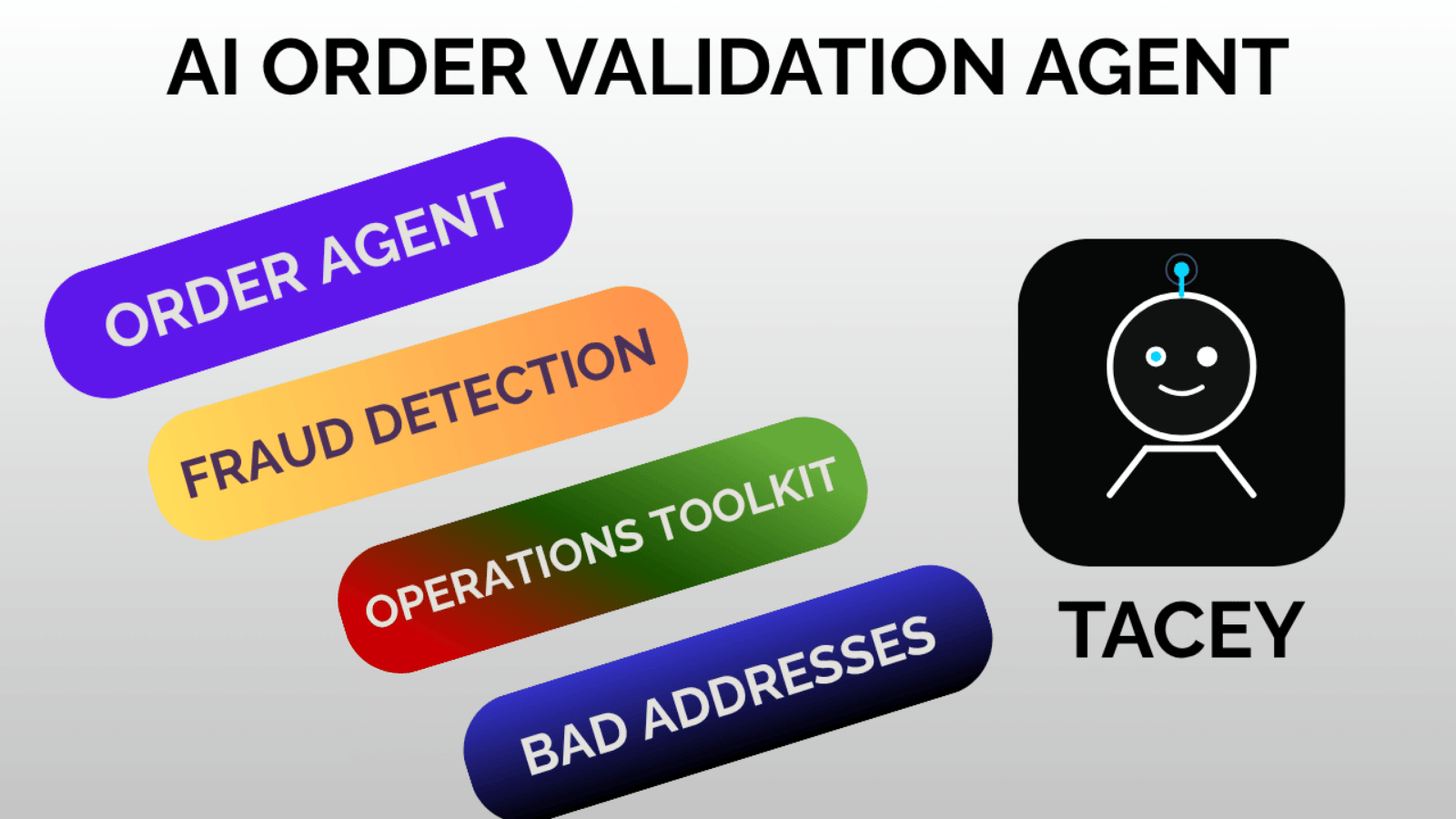

Shopify merchants have always had a fulfillment problem that no one talks about directly. It is not fraud. It is not returns. It is the gap between the moment a customer clicks pay and the moment a label prints. In that gap, bad orders move forward unchecked. Addresses that look valid get shipped. Duplicate orders that should have been caught sit in the queue. Fraud signals that were there all along get missed because no one was looking at the right layer.
That gap is why Tacey was built. And as of May 1, 2026, Tacey is publicly available on the Shopify App Store to every merchant who ships physical goods.
This article covers what Tacey is, why it was built at the order layer rather than the checkout layer, and what it means for Shopify merchants who are running stores at any volume.
What the Shopify App Store Approval Means
Shopify is not a casual platform. It is estimated that more than 6.9 million merchants sell using the Shopify platform, and the Shopify App Store contains over 13,000 apps. Getting listed is not a formality. Every app that goes through the Partner Dashboard review process is evaluated against a compliance checklist that covers data handling, GDPR webhooks, protected customer data access, UI/UX alignment with Polaris design standards, and functional accuracy in a live test environment.
Tacey completed that review and is now live as of May 1, 2026. The app was not submitted until the entire compliance surface was clean: GDPR webhooks registered, protected data access approved by Shopify directly, Polaris design alignment confirmed, and a full screencast demonstrating the core loop from order creation to resolution.
The Shopify App Store is the distribution channel that matters most for a Shopify-native tool. Approximately 87% of Shopify merchants use apps to enhance their eCommerce operations, and the average merchant installs six apps to optimize their store. Being listed means organic discovery is now open. Merchants searching for order validation, fraud detection, or order automation tools can find Tacey directly in the App Store search results.
The Problem Tacey Was Built to Solve
To understand why Tacey exists, it helps to understand where existing tools break down.
The dominant approach to order quality on Shopify has been checkout validation. These tools show the merchant an address suggestion at checkout. The customer can accept it or ignore it and pay anyway. If they ignore it, the order goes through with whatever address they entered. The checkout tool has done its job. The bad order is now your problem.
That structural limitation gets worse when you account for where Shopify orders actually come from in 2026. Shop Pay lets customers pay with a saved address in one tap, with no checkout screen that fires. Apple Pay and Google Pay use native wallet flows that bypass Shopify checkout extensions entirely. TikTok Shop, Instagram Checkout, and other social commerce channels load their own checkout UI, not Shopify's. And as agentic storefronts become more common, AI shopping assistants place orders programmatically with no human at a browser at all.
Checkout validation cannot touch any of these channels. It was never designed to. It lives at a layer that only applies to a portion of your orders, and that portion is shrinking as commerce becomes more distributed.
The 2.1% bad address rate cited by Shippo applies across all orders, not just the ones placed through a traditional browser checkout. A store doing 500 orders a month has roughly 10 problem orders every single month regardless of which checkout tools they have installed. At FedEx's current address correction rate of $25.50, that is $255 in carrier fees alone, before reshipment costs, support time, and the customer who does not order again because their package went to the wrong address.
Loqate has reported that 74% of companies say bad address data causes up to 25% of failed deliveries. The problem is not a checkout problem. It is a data quality problem that persists after payment, and it needs to be solved at the layer where every order passes through regardless of origin.
That layer is the order layer. Tacey operates there.
How Tacey Works
Tacey sits between payment and fulfillment on every order placed in a Shopify store. The moment a customer pays, Tacey reads the order. It does not wait for a webhook delay or a manual review. It runs an analysis across multiple dimensions simultaneously: delivery address validity, fraud signal combinations, duplicate order patterns, order completeness, and flagged customer history.
Based on that analysis, Tacey makes one of three decisions.
PASS. The order is clean. It gets tagged, logged with the full reasoning chain, and released to fulfillment. The merchant never knew Tacey ran.
AUTO-RESOLVE. The order has a correctable issue. A malformed address component, a missing unit number that can be inferred from postal data, a format issue that does not affect deliverability. Tacey corrects it silently, writes the fix back to the Shopify order, and releases it. No hold. No customer contact. No merchant action required.
FLAG. The order has a real problem that requires customer input. Tacey places a fulfillment hold in Shopify, sends the customer a branded email from the merchant's own domain with a one-click address correction link, and waits. When the customer corrects the address, Tacey validates the fix, writes it back to the order, and releases the hold. The merchant did nothing. Their warehouse never saw a bad order.
For orders with confirmed fraud signals, or when the merchant has configured SMS or voice escalation, Tacey can contact the customer through additional channels before the order times out. Commander plan merchants have access to AI voice calls through the escalation stack.
Every decision, for every order, is logged in full. The decision log shows the reasoning chain: which signals fired, what confidence level they produced, which path was taken, and how long resolution took. There are no black boxes. Merchants can see exactly why Tacey did what it did on any order at any time.
The Operations Toolkit
The order agent is the core product. It is what most merchants will install Tacey for. But Tacey ships with something broader: a full Operations Toolkit built directly into the same dashboard, included on every plan.
The Toolkit exists because the data layer that catches bad orders contains a lot more useful signal than just delivery address quality. Order history, customer behavior patterns, discount usage, SKU performance, fulfillment timing, and cross-order fraud signals are all present in the same pipeline. The Toolkit surfaces that data as operational tools merchants can act on.
The current Toolkit covers six areas.
Fulfillment Management gives merchants bulk actions, WISMO risk flagging, and 3PL integration controls. Discount Intelligence covers discount code tracking, fraud cross-referencing, expiry management, and A/B campaign comparison across codes. The Intel Hub provides customer risk tiers, RFM spend profiles (Platinum, Gold, Silver, Bronze, auto-computed), cohort retention analysis, win-back segments, and abandoned cart recovery tooling. Catalog Health handles SKU monitoring, variant health scoring, out-of-stock tracking, and bulk metafield operations. Store Analytics delivers order-level profitability, fulfillment performance tracking, and AI decision trend reporting. Customer analytics shows customer-level spend tiers, address quality scores, and repeat flagging history.
All of this is accessible from a single install. Merchants do not need a separate analytics app, a separate discount management app, or a separate customer intelligence tool. The operational data is already in Tacey's pipeline because it runs on every order. The Toolkit is what you get when you surface that data in a usable form.
What Channels Tacey Covers
One of the clearest differentiators in Tacey's positioning is channel coverage. Because Tacey operates at the order layer rather than the checkout layer, it sees every order that enters Shopify regardless of where it originated.
Shop Pay orders with saved addresses go through Tacey. Apple Pay and Google Pay orders that bypassed the checkout extension go through Tacey. TikTok Shop and Instagram Checkout orders that loaded their own UI go through Tacey. Headless storefront orders, custom checkout implementations, and draft orders created manually in the Shopify admin all go through Tacey.
If it is an order in Shopify, Tacey reads it.
This is a structural difference from checkout validation tools, not a feature comparison. Checkout tools are built for one channel: the browser checkout. Tacey is built for the order layer, which is channel-agnostic by design. As commerce continues to distribute across more surfaces, the relevance of checkout-layer tools decreases. The order layer stays constant.
Who Tacey Is Built For
Tacey is designed for Shopify merchants who ship physical goods and run on order volume where manual review is not realistic.
At 100 orders a month, a merchant might catch problems manually. At 300 orders a month, they are already missing things. At 500 orders a month, manual review is a part-time job that no one actually has time for. At 1,000 orders a month and above, it is operationally impossible without tooling.
The 2.1% bad address rate means that even a store doing 200 orders a month has 4 to 5 problem orders every month. Each one requires merchant time, customer communication, potential carrier fees, and potential reshipment. Tacey handles all of that automatically.
The app is also built for merchants selling across multiple channels. If your store is connected to TikTok Shop, Instagram Shopping, or any headless front end alongside your main Shopify storefront, Tacey provides unified order intelligence across all of them from one install.
Pricing and Plans
Tacey is available on three plans, all with a 7-day free trial and free to install from the Shopify App Store.
Scout is $39 per month and covers up to 500 orders per calendar month. It includes the full order agent with PASS, AUTO-RESOLVE, and FLAG decisions, address validation in 195 countries, automatic bad-address email to customers, pre-shipment reminders, duplicate order detection, and access to the core Operations Toolkit apps.
Agent is $59 per month and covers up to 1,500 orders per calendar month. It includes everything in Scout plus fix emails sent from the merchant's own store domain, pre-ship reminders via email and SMS, balanced and aggressive detection and sensitivity modes, 20+ Operations Toolkit apps, and a custom email sending domain.
Commander is $99 per month with unlimited orders. It includes everything in Agent and Scout plus AI voice call escalation, address connection via voice and SMS, a custom plain-language rules engine, pre-fulfillment reminders to customers, advanced analytics and address trend reporting, full Toolkit access plus customer intelligence, and custom integration on demand.
All plans include the full decision log, the Operations Toolkit at the plan's tier level, and the three-decision pipeline on every order.
What Happens Next
There are approximately 5.6 million live Shopify stores worldwide as of 2026. Shopify stores increased 11% year-over-year in 2026 Q1. The platform is growing, the order volumes that flow through it are growing, and the number of channels through which those orders arrive is growing. Every one of those trends increases the surface area of the problem Tacey solves.
The Shopify App Store approval is the start of distribution, not the end of development. The Toolkit roadmap continues with additional intelligence layers across discount fraud, customer watchlists, and carrier-level analytics. The order agent is being extended with more signal categories and deeper integration with the Shopify Flow trigger library for merchants who want to build custom automation on top of Tacey's decisions.
For merchants who want to see it in action before committing, the 7-day free trial starts the moment you install. The setup wizard takes under five minutes. Observe mode lets you see every decision Tacey would have made on your real orders before you switch it live.
Install Tacey on the Shopify App Store and visit Tacey to learn more about the full platform.