 tacey
tacey Install on Shopify

Voice shopping is no longer a concept merchants can defer. In 2026, voice commerce represents a $72.8 billion global market according to Roots Analysis, and that number is projected to reach $923 billion by 2040. For Shopify merchants, this is not an abstract trend. It is a shift in how customers discover, research, and buy products. The stores that optimize for it now will capture traffic their competitors miss entirely.
The real opportunity is not in voice transactions themselves. Only a small share of voice interactions end in a completed voice-only purchase. The opportunity is in the research phase: the questions customers ask out loud before they ever open a browser. Capturing that traffic, owning those answers, and building brand familiarity in the voice channel is where Shopify merchants can win in 2026.
This article breaks down where voice shopping actually stands, what your store needs to handle it, and the specific steps you can take without a developer.
Is voice shopping a real trend for Shopify stores?
Yes. Voice commerce is a $72.8 billion market, but the main opportunity is capturing customer research queries. While only 11.5% of users buy with voice, 51% use it for product research. This creates a new top-of-funnel channel for merchants to win before a customer even opens a browser.
Ringly.io reports that 157.1 million US users are projected to use voice assistants in 2026, with 8.4 billion voice-enabled devices active worldwide. That is more devices than there are people on earth. Smart speaker penetration in US households now exceeds 35%. This means roughly one in three American homes has a device that can query your store at any moment.
However, actual purchase completion via voice is still limited. Only 11.5% of smart speaker owners complete a monthly purchase entirely by voice. The larger behavior is research. 51% of voice shoppers use voice to research before buying. Build Grow Scale reports that 27% of online shoppers use voice search specifically for product research. The gap between research and purchase is deliberate. Customers ask Alexa about a product, then switch to their phone or laptop to buy.
How do voice searches differ from typed Google searches?
Voice queries are much longer and more conversational, averaging 29 words compared to 3 to 4 for typed searches. They are often phrased as specific, natural-language questions. This format reveals a customer's exact needs and shows they are further down the purchase funnel.
For example, a typed query might be "leather laptop sleeve." The same search by voice could be, "What is the best slim leather laptop sleeve that fits a 15-inch MacBook and ships within two days?" That second query is more specific and has less competition. The stores that structure their content to answer questions like this are the ones that voice assistants read aloud.
Digital Applied reports that voice queries now represent 27% of all global search volume in 2026. Furthermore, 72% of voice search queries are phrased as questions according to PwC data cited by easyappsecom.com. This means FAQ-style content directly aligns with how voice assistants find answers.
Where do voice assistants like Alexa get their answers?
Voice assistants primarily pull answers from Google's featured snippets, also known as position zero, and from AI Overviews. They select a single answer and read it aloud. Data from Backlinko shows 40.7% of voice answers come directly from featured snippets, making this the most important target for optimization.
This narrows your target significantly. Ranking on page one is useful. But earning position zero for a question your customers are asking is what gets your store read aloud on a smart speaker. Digital Applied confirms that these features are the primary pipeline for voice results. Pages with structured data are 2.2x more likely to be selected as voice answers.
What is structured data and why does it matter for voice search?
Structured data is code that explains your content's meaning to search engines and AI systems. It is critical for voice search. According to Stackmatix, content with proper schema markup has a 2.5x higher chance of appearing in AI-generated answers and can see up to 40% more AI Overview appearances.
For Shopify stores, there are four schema types worth prioritizing:
- Product schema: Added automatically by Shopify, this tells search engines the product name, price, availability, and brand.
- FAQPage schema: This is the highest-leverage addition for most stores. It enables question-answer dropdowns in search results and makes your content eligible for voice responses.
- Speakable schema: This explicitly marks sections of your page as intended for audio delivery, telling assistants like Google that the content is formatted to be read aloud.
- BreadcrumbList schema: This improves site structure understanding and helps AI systems navigate your store's content hierarchy.
A warning from Fudge.ai: installing multiple SEO apps can create duplicate schema conflicts. If you have three apps all adding Product schema, the overlap creates errors that prevent rich results. Always test your pages with Google's Rich Results Test.
How should I write content to be found by voice search?
Write in a conversational, question-answering format. Structure content to directly answer the natural-language questions customers ask. Use question-based headings and place concise, 40 to 50-word answer blocks at the top of sections so a voice assistant can read them aloud without changes.
This applies to four types of content on your Shopify store:
- Product descriptions: Instead of "Premium 15-inch laptop sleeve," write "This laptop sleeve fits MacBook Pro 15-inch and 16-inch models and ships within one business day."
- Blog posts and guides: Use question-based headings like "How do I choose the right running shoes?" instead of generic titles.
- FAQ sections: Add conversational FAQs to product pages, as noted by addwebsolution.com. This directly feeds voice results and AI Overviews.
- Collection pages: Include intro paragraphs that answer common category-level questions, such as "What are the best hiking boots for wide feet?"
Build Grow Scale advises filtering Google Search Console for queries with seven or more words. These long-tail questions are almost certainly voice searches and are your most actionable starting point.
Does page speed affect my store's ranking in voice search?
Yes, page speed is a critical ranking factor. The average voice search result page loads in 4.6 seconds, which is 52% faster than the average web page, according to Backlinko data. Slow stores that fail Google's Core Web Vitals are often disqualified from voice results before their content is even considered.
For Shopify merchants, page speed optimization centers on a few specific actions. Compress and properly size all product images. Remove unused Shopify apps, as every app adds code to your storefront. Use a performance-focused theme. addwebsolution.com confirms that Google favors pages that load in under three seconds on mobile for all search results.
Which products sell best through voice shopping?
Voice shopping works best for two product categories. First are low-cost, replenishable items like groceries and household essentials, which have a $34 average order value according to easyappsecom.com. Second are higher-consideration products where voice is used for initial research before the purchase is completed on a screen.
For replenishable items, voice offers a frictionless reorder path for customers who know what they want. For more expensive items, appearing in voice research builds brand awareness. The customer who heard your brand name read aloud by an assistant is more likely to click your result when they follow up with a typed search. The Technavio market report highlights this trend toward multimodal commerce, where voice is the input and a screen is the output.
What is agentic commerce and how does it relate to voice?
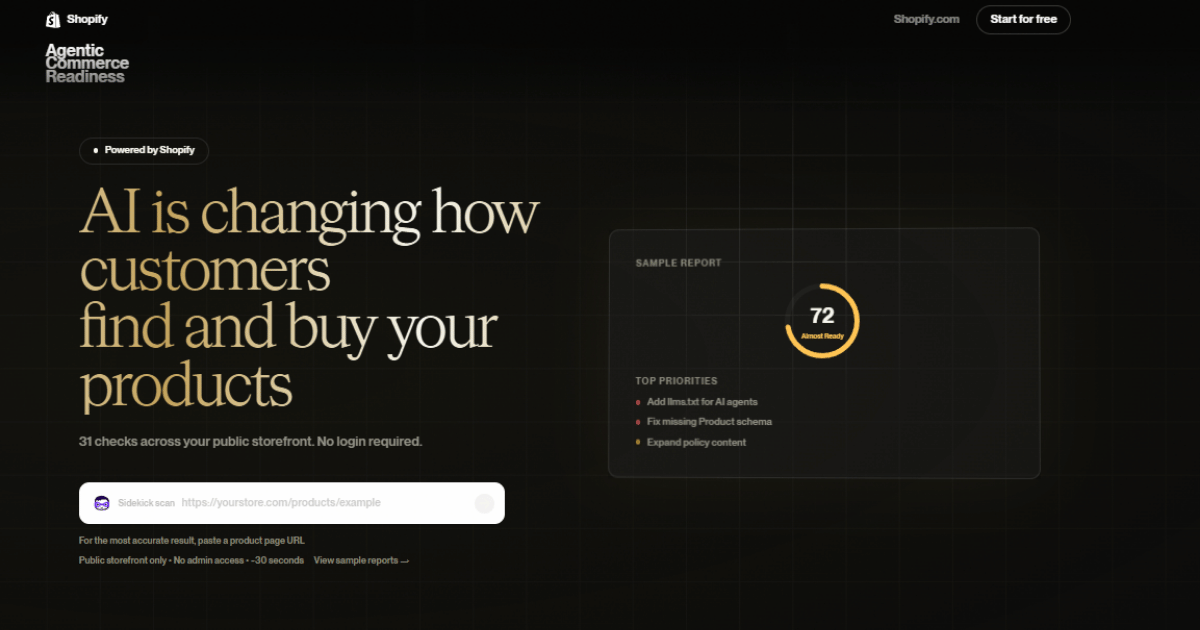
Agentic commerce is when AI agents browse, compare, and purchase on a user's behalf. It is the next evolution of voice search. The same structured data, accurate inventory, and fast page speeds needed for voice optimization are what AI agents will use to discover and trust your store.
According to Technavio, the rise of agentic commerce is a key trend. Shopify's Universal Commerce Protocol, launched in January 2026, creates a direct pathway for AI agents to query Shopify stores. The work you do for voice in 2026 is also the work that positions your store for AI agent discovery in 2027 and beyond.
How can I start optimizing my Shopify store for voice search?
You can start without a developer by auditing Google Search Console for long-tail questions. Add FAQ sections to top product pages using an app that generates schema. Rewrite product descriptions to be conversational, and check your Core Web Vitals for page speed issues that need fixing.
Here are five high-leverage actions:
- Audit Google Search Console for queries with 7 or more words to find existing voice traffic.
- Add FAQ sections to your top five product pages using an app that adds FAQPage schema automatically.
- Rewrite product description introductions to answer "What is this and who is it for?" in natural language.
- Check your Core Web Vitals in Search Console and address pages that fail speed thresholds.
- Add a conversational intro paragraph to your highest-traffic collection pages to target category-level questions.
How does voice shopping affect order accuracy and fulfillment?
Voice shopping can increase order volume but may also introduce more address errors. Customer data is often pulled from an account or spoken aloud, which creates formatting variations. With 2.1% of all e-commerce parcels carrying bad addresses according to Shippo data, this operational layer becomes more critical to prevent failed deliveries.
A customer might find you through voice search, place an order based on trust, and then have the package fail to deliver because of a small address error. The post-checkout order layer is where that trust breaks. This is the operational layer that sits between your marketing and your fulfillment.
Tacey operates at that layer. It sits between payment and fulfillment on every Shopify order, checking the address and letting the customer fix their own order before the label prints. Plans start at $29 a month for 750 orders and scale with order volume, with a 14-day free trial.
As voice commerce adds more orders at higher velocity, the order operations layer becomes more important, not less. Winning the voice traffic is the marketing job. Making sure those orders ship correctly is the operations job. Both matter.
Frequently asked questions
What percentage of voice search answers come from featured snippets?
According to Backlinko data, 40.7% of all voice search answers are pulled directly from Google's featured snippet. This makes optimizing for "position zero" more important than a standard page-one ranking for capturing voice traffic.
How much faster do pages need to be for voice search?
The average page that ranks in voice search loads in 4.6 seconds, which is 52% faster than the average web page. Google favors pages that load in under three seconds on mobile devices, making page speed a non-negotiable factor for voice eligibility.
What is the easiest way to add FAQ schema to a Shopify store?
The simplest way is to use a Shopify app like HelpCenter or FAQs by Relishify, as mentioned by sources like Digiinte. These apps automatically generate the correct FAQPage schema when you build FAQ sections through their interface, without needing to write code.
Can installing too many SEO apps hurt my store?
Yes. As noted by Fudge.ai, installing multiple SEO apps can create duplicate schema conflicts. This happens when several apps try to add the same type of structured data, causing errors that can prevent your pages from appearing in rich results or voice search.
What is Speakable schema?
Speakable schema is a type of structured data that explicitly marks sections of a page as being ideal for audio playback. It signals to voice assistants that your content is formatted to be read aloud, making it a forward-looking optimization for voice search.
What kind of products are most often bought directly with voice?
Replenishable and repeat-purchase items dominate direct voice transactions. These are typically low-cost consumables like groceries, personal care products, and household essentials. The average order value for these purchases is around $34.
 Install on Shopify