 tacey
tacey Install on Shopify

For years, the product recommendation engine was the most powerful conversion tool a Shopify store could deploy. Show customers what similar buyers purchased. Surface related items. Present frequently bought together combinations. Measure the lift in average order value. Repeat.
In 2026, that model is being disrupted at its foundation. This is not because recommendation engines stopped working. It is because AI is changing who makes the recommendation and when. The shift from merchant-controlled suggestions to AI agent-mediated discovery is underway. It changes what Shopify merchants need to optimize, where they need to show up, and how their product data needs to be structured.
This article explains what is actually changing, what still works, and what merchants need to do right now.
How do traditional product recommendation engines work?
Traditional engines use three main methods. Content-based filtering suggests similar items based on product attributes. Collaborative filtering uses the behavior of similar shoppers to predict what a customer will want. Hybrid systems combine both approaches. These engines operate inside your store on pages you control, showing suggestions to customers who are already visiting.
Shopify's own documentation describes these core approaches. Content-based filtering works well for new stores with limited purchase history. Collaborative filtering powers the "customers who bought this also bought" logic and requires more transaction volume to function well. These systems are placed by merchants on product pages, in cart drawers, and in post-purchase emails.
The key assumption is that the merchant controls the entire experience inside their own store. That assumption is what is breaking down.
How is AI changing the way customers find products?
AI is shifting product discovery outside of your store. Instead of visiting your site first, customers ask AI agents like ChatGPT for recommendations. These agents create shortlists of products from many stores. If your products are not structured for AI evaluation, you will not be on that list.
A meaningful portion of product discovery now happens before a customer visits your store. eMarketer reports that AI platforms are expected to account for $20.57 billion in US retail spending in 2026. Bain and Company data cited by Microsoft estimates 30% to 45% of US consumers already use generative AI to research products.
A separate commercetools report found that 73% of consumers are using AI in their shopping journey. 58% have replaced traditional search with generative AI tools for product recommendations. When a customer asks an AI for a product, they are not on your page and will not see your widgets. If you are not on the AI's list, you were never in the conversation.
What kind of product information do AI agents look for?
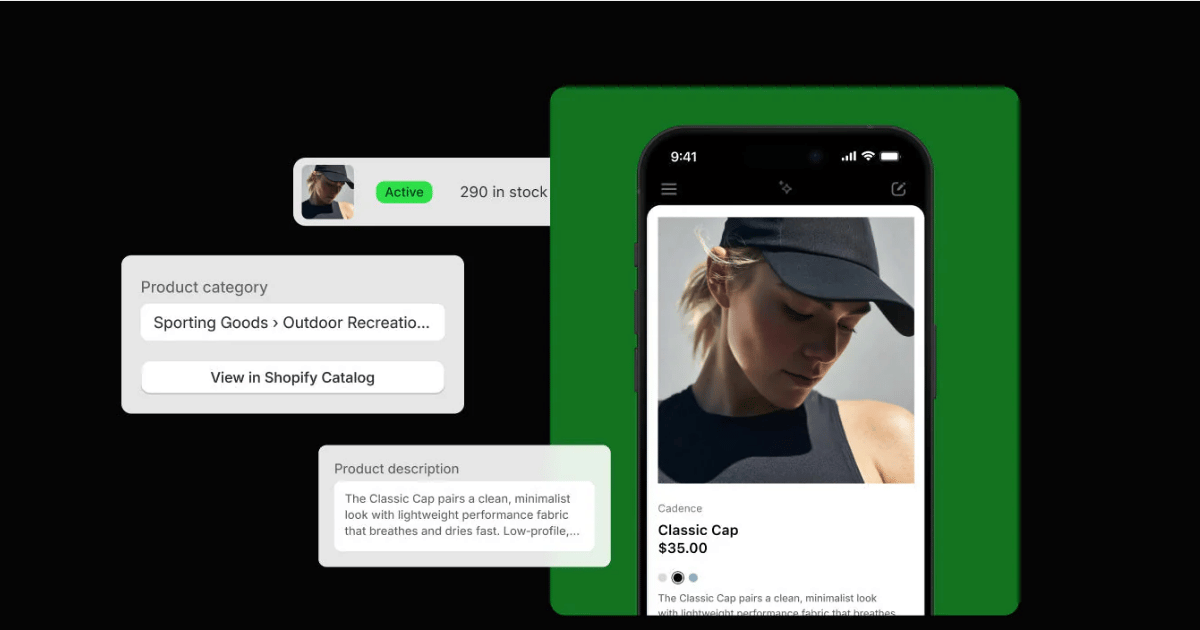
AI shopping agents require clear, structured, machine-readable data. They cannot interpret vague descriptions or incomplete specifications. An AI will prioritize a product with precise, structured data over one with beautiful design but unclear details. This concept is known as "agent legibility" and it is critical for discovery.
Human shoppers tolerate ambiguity. They interpret vague descriptions and make judgments based on photography. AI agents cannot. nShift identifies this as "agent legibility." If your delivery windows or return policies are buried in dense paragraphs, an agent may skip the offer entirely.
Hashmeta notes that tactics like persuasive copy and emotional branding must evolve. Algorithmic decision-makers prioritize structured data and verifiable specifications. For Shopify merchants, this means the optimization target is no longer primarily visual. It is structural. A plain page with precise data beats a beautiful page with vague information.
Are traditional product recommendation apps still effective?
Yes, traditional recommendation engines still work for customers already on your site. Data shows they can increase average order value by 15 to 30% and revenue per visitor by 35%. However, they do not help you reach customers who use AI for discovery before visiting a store.
easyappsecom.com reports that stores with active recommendations see real results. Apps like Rebuy, Nosto, and Wiser continue to deliver returns. But a Medium analysis adds a critical nuance. Shopify's own native AI features underperform traditional algorithms by 12 to 18% in early data.
The same analysis cites McKinsey research finding that only 23% of AI implementations in e-commerce produce measurable ROI in the first year. The lesson is that "AI-powered" does not guarantee better results. What is changing is not whether in-store recommendations work. It is that they only reach customers already on your site.
What is Answer Engine Optimization (AEO) for Shopify?
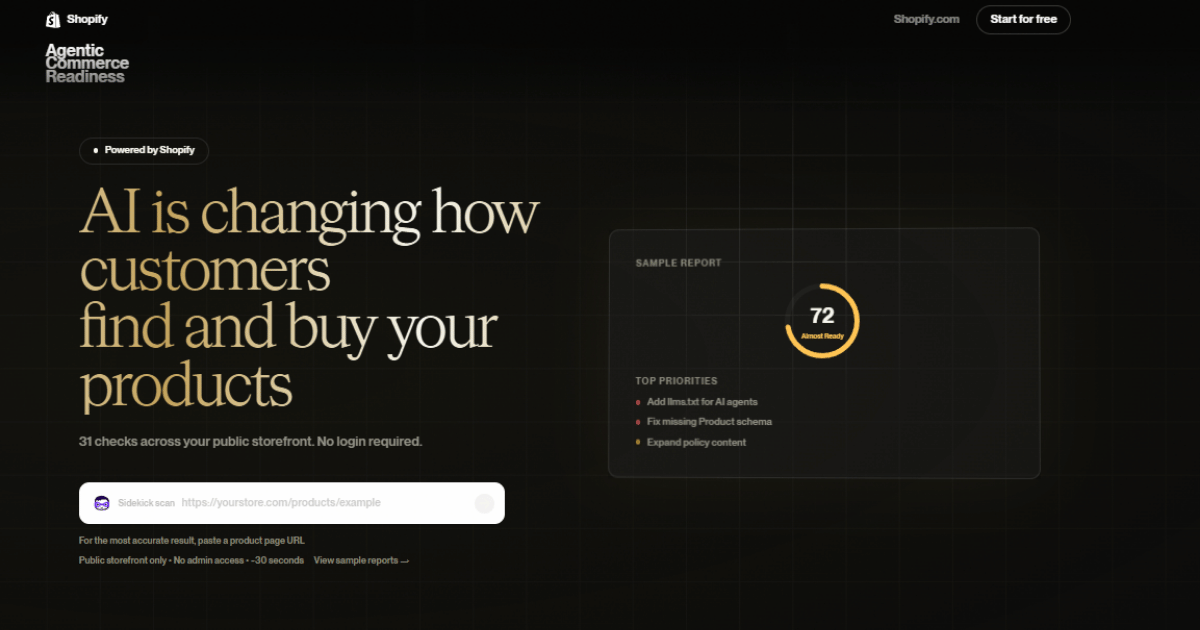
Answer Engine Optimization (AEO) is the practice of structuring your product data so AI agents can find, understand, and recommend your products. It is the equivalent of SEO for AI-driven shopping. AEO focuses on clean data, schema markup, and clear fulfillment promises to make your products "agent-legible."
eMarketer describes AEO as structuring content for AI evaluation. Commercetools identifies structured data, metadata, and clean catalogs as key inputs. For Shopify merchants, AEO translates to specific actions.
- Clean and complete product data. Every product needs a specific title, precise dimensions, clear materials, and accurate pricing. Vague claims like "premium quality" provide nothing an agent can use. Specific claims like "water-resistant to 10,000mm" are agent-readable.
- Structured schema markup. Product schema tells AI agents what your product is, what it costs, and if it is in stock. FAQ schema creates question-answer pairs that agents use to answer customer queries.
- A clean and accurate llms.txt file. This new standard tells AI systems which pages contain authoritative information. IFG eCommerce notes this directs AI to structured feeds, reducing the risk of misreading data.
- Consistent fulfillment promises. nShift points out that AI agents learn from your fulfillment track record. If delivery times are inconsistent, agents will downgrade your reliability score over time.
How is Shopify preparing merchants for AI-driven commerce?
Shopify is actively building the infrastructure for agentic commerce. It co-developed the Universal Commerce Protocol (UCP), an open standard that lets AI agents shop across different retailers. This means Shopify stores with clean product data can be discovered by multiple AI platforms without needing separate integrations for each one.
According to Ekamoira, UCP was co-developed with partners like Etsy, Wayfair, and Target. Over 20 global partners, including Stripe and Mastercard, have endorsed it. This gives Shopify merchants access to every AI platform that supports the protocol.
Shopify's own generative recommender, detailed in a February 2026 Shopify Engineering post, runs on data from billions of shopping interactions. During BFCM 2025 alone, Shopify processed 2.2 trillion edge requests. The platform's investment in this infrastructure benefits all merchants who maintain clean data.
Should I focus on AEO or in-store recommendations?
You should focus on both. Use in-store recommendation engines to convert undecided customers who are already on your site. Use Answer Engine Optimization (AEO) and structured data to attract new customers who use AI agents for product discovery before they choose which store to visit.
In-store engines solve the problem of undecided customers on your site. The ROI is well-documented. Top options for DTC stores include:
AEO and structured data solve the problem of reaching customers who have not visited you yet. A March 2026 EMARKETER survey notes that most AI shoppers use agents to build a shortlist, then do their own research. The on-page experience still matters. Strong photography, genuine reviews, and fast page speed remain important.
What operational problems does AI shopping create for merchants?
AI-driven shopping increases the risk of fulfillment errors. Agents place orders using stored customer data, which may be outdated. This can lead to a higher rate of incorrect shipping addresses. Since agents reduce manual review at checkout, the post-purchase operations layer becomes more critical to manage.
An AI agent can find a product, compare prices, and click buy. It cannot verify that a shipping address is current or handles apartment numbers correctly. Shippo data shows that 2.1% of all e-commerce parcels carry bad address information. As agentic ordering increases, this rate may also increase.
This is the post-checkout layer. Winning the AI agent recommendation is the discovery problem. Making sure the resulting order ships correctly is the operations problem.
Tacey handles the operations layer. It sits between payment and fulfillment on every Shopify order, checking the address and letting the customer fix their own order before the label prints. Plans start at $29 a month for 750 orders and scale with order volume, with a 14-day free trial.
As agentic commerce sends more orders at higher velocity with less human review at checkout, the post-checkout order layer becomes a more important part of the merchant's operations stack.
Frequently asked questions
What is agentic commerce?
Agentic commerce is when AI assistants, or agents, research and compare products on behalf of a consumer. This discovery happens before a customer visits a specific store, changing the focus from on-site recommendations to making product data readable by AI.
What is the difference between AEO and SEO?
Search Engine Optimization (SEO) structures content for search engines like Google to rank web pages. Answer Engine Optimization (AEO) structures product data for AI agents to evaluate and recommend specific products, focusing on machine-readable details over persuasive copy.
Do I still need a product recommendation app on my Shopify store?
Yes, in-store recommendation apps are still valuable. They help convert shoppers who are already on your site by increasing average order value and revenue per visitor. They solve a different problem than AEO, which is focused on attracting new customers.
Why is structured data so important for AI?
AI agents cannot interpret vague marketing language or incomplete product details. They rely on structured, machine-readable data like schema markup to compare products on specifications, price, and availability. Without it, an agent may skip your product entirely.
What is the Universal Commerce Protocol (UCP)?
The Universal Commerce Protocol is an open standard co-developed by Shopify that allows AI agents to shop across different retailers. By making your product data UCP-compatible, you can be discovered by many AI platforms without building individual integrations.
How do I make my products ready for AI agents?
Focus on clean product data with precise specifications, use structured schema markup, and maintain an accurate `llms.txt` file. Also ensure your fulfillment promises are consistent, as AI agents learn from your track record of on-time delivery.
 Install on Shopify