 tacey
tacey Install on Shopify
On March 24, 2026, Shopify quietly flipped a switch that changed how over five million merchants get discovered. No app to install. No ad budget required. No integration to build. Every eligible Shopify store became discoverable inside ChatGPT, Microsoft Copilot, and Google AI Mode by default, through a feature called Agentic Storefronts.
Most merchants received an email from Shopify and moved on with their day. That was a mistake. This is not a minor channel update. It is a structural shift in how customers find and buy products online, and the merchants who understand it now will be meaningfully ahead of those who catch up later.
This article explains what Agentic Storefronts actually are, how product discovery works inside AI platforms, what it means for your operations, and what you should do today to make your store show up strong.
What Shopify Agentic Storefronts Actually Are
Shopify Agentic Storefronts are a set of tools that package your product catalog, checkout, and brand information in a format AI platforms can natively present inside a conversation. When a user asks ChatGPT for recommendations on insulated travel mugs under $30, the AI agent searches for appropriate products and returns results. If your store is in Shopify Catalog and you sell to US shoppers, your products are candidates for those results.
The setup is one-time and centralized. You go to Settings > Sales Channels in your Shopify admin, and from there you can toggle AI channels on or off individually. Shopify Catalog then handles the syndication: your product data is kept synchronized across ChatGPT, Google AI Mode, Gemini, and Microsoft Copilot in real time. Inventory accuracy, pricing, and product details stay current without any ongoing maintenance on your part.
Orders that originate from AI channels flow into your admin with full channel attribution. You can see exactly which AI platform drove each sale. You remain the merchant of record, owning the customer relationship and the post-purchase experience. Shopify does not charge an additional fee for the feature itself, though OpenAI takes a 4% fee on sales completed through ChatGPT, on top of standard processing rates. Google AI Mode and Gemini currently charge no additional fees.
The Demand Signal Is Already There
Before getting into how discovery works, it is worth understanding the scale of what is already happening.
AI-driven traffic to Shopify stores has increased 7x since January 2025, and AI-attributed orders on the platform grew 11x over the same period. That is not a rounding error. Shoppers are already using AI assistants as product research tools, and in many cases as the first touchpoint of a buying journey.
McKinsey projects AI agents could facilitate $3 trillion to $5 trillion in global commerce by 2030. Whether that figure proves accurate or not, the direction is not in question. AI is becoming the front door to commerce for a growing segment of buyers. The question for merchants is not whether to care about this channel. It is how to show up well in it.
How AI Platforms Actually Discover and Rank Products
To show up in AI conversations, you first need to understand how these systems work. They are not search engines. They do not index pages and rank keywords the way Google does. They reason about product data.
When a shopper asks an AI agent for recommendations, the agent needs to assess which products best match the intent behind the query. For that, it needs structured, factual, comprehensive product information it can reason about. Vague descriptions and keyword-stuffed bullet points work against you here. Natural language that explains what your product is, who it is for, what makes it different, and when someone would choose it over alternatives, that is what AI agents parse and use to make recommendations.
Shopify Catalog uses specialized AI models to categorize, enrich, and standardize product data across billions of items. It infers categories, extracts attributes, consolidates variants, and keeps pricing and inventory current across all connected AI channels. Your catalog data is the raw material. The quality of that data determines how accurately and how often your products surface.
The four major platforms currently active for Shopify merchants each approach this differently:
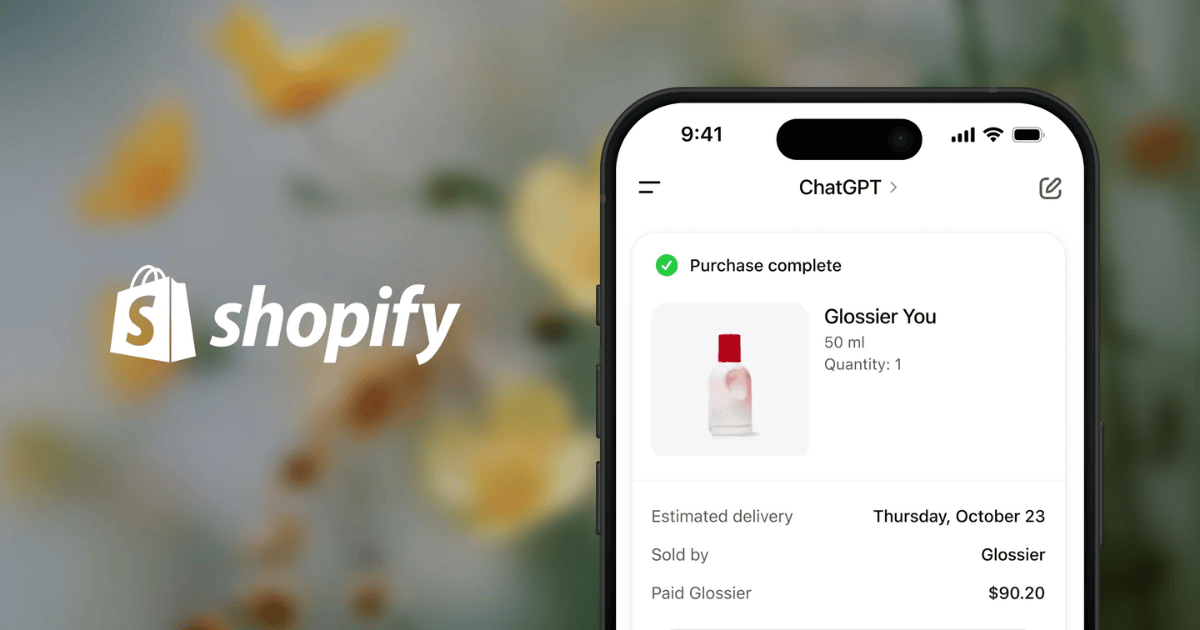
ChatGPT functions primarily as a discovery channel. Users browse and compare products inside the conversation, then complete their purchase on your store through an in-app browser on mobile or a new tab on desktop. OpenAI explored in-chat purchasing with Instant Checkout but scaled it back in March 2026 after finding that users preferred completing transactions on familiar retail environments where they already have accounts and saved payment methods. ChatGPT is a top-of-funnel discovery tool, not a checkout replacement.
Google AI Mode and Gemini are in early access and rolling out to eligible merchants through the admin. Google co-developed the Universal Commerce Protocol (UCP) with Shopify, an open standard for AI agents to connect and transact with any merchant. Native shopping in Google AI Mode means your products can appear directly in Google search results when someone is in an AI-driven query session. Google currently charges no additional transaction fees.
Microsoft Copilot has a live embedded checkout experience, meaning users can complete purchases without leaving the conversation. The Copilot integration is managed from the same Agentic Storefronts toggle in your admin.
What Changes for Product Discovery
Traditional product discovery followed a predictable path: shopper types a query into Google, clicks through to a store, browses, and buys or bounces. SEO, paid ads, and content marketing all competed for that click at the search engine layer.
Agentic discovery removes the click. A shopper asks ChatGPT what running shoes work best for someone with wide feet and a $120 budget. ChatGPT reasons across available product data, surfaces three to five candidates, explains why each one fits the criteria, and provides a path to purchase. The shopper may never see a search results page. They may never land on your product page through organic search.
This has real implications:
Your product page is no longer always the first impression. For a growing segment of shoppers, the AI's summary of your product is the first impression. How your product data reads when processed by a language model matters as much as how your product page looks in a browser.
Reviews and ratings matter more, not less. AI agents factor in social proof when making recommendations. A product with strong, substantive reviews is a better recommendation than an equivalent product with thin or no reviews. This is an area where existing SEO best practices and AI optimization converge.
Availability and pricing accuracy become critical. If your catalog data shows a product as in stock but it is not, or your pricing is out of date, the experience breaks at the moment of highest intent. Shopify Catalog syncs this data in real time, but that only works if your inventory management is accurate on the backend.
Channel attribution shifts. Traffic from AI channels will show up in your admin with source attribution, but the journey looks different from paid or organic traffic. Someone who first encountered your brand in a ChatGPT conversation and then searched for you directly or revisited your site later may appear as direct traffic. Understanding the true role AI discovery plays will require looking at conversion patterns over time, not just last-click attribution.
The Order Operations Gap Nobody Is Talking About
Here is something almost no coverage of Agentic Storefronts mentions: when a customer discovers your product in ChatGPT and completes a purchase on your store, that order arrives through your standard Shopify webhook infrastructure. The discovery happened in a conversation. The order is identical to any other order in your system.
But the customer journey that produced it is different in one important way. The shopper using an AI agent to purchase on their behalf may be operating faster, with less friction, and with less attention to address details than a shopper manually navigating your checkout. AI-facilitated purchases can introduce the same address errors that any checkout does, including mismatched postal codes, truncated apartment numbers, and invalid address formats.
The point is not that AI orders are riskier. The point is that as AI-originated order volume grows, the operational processes downstream of the order need to be as robust as the discovery layer upstream. Getting discovered in ChatGPT is only half the job. Fulfilling that order accurately is the other half.
Apps like Tacey operate at the order webhook layer, sitting between payment confirmation and fulfillment. Regardless of where the order originated, Tacey reads every order the moment it is placed, validates the address, checks for risk signals, and either passes it forward, auto-resolves minor issues, or holds and contacts the customer before the warehouse ever sees the problem. As AI-originated order volume scales, that layer of protection becomes more important, not less.
How to Optimize Your Store for AI Discovery
Most of what you need to do to show up well in AI channels is not new work. It is an extension of what good product content has always required. The difference is the audience: you are writing for a system that reasons, not a system that ranks.
Write product descriptions that explain context, not just specs. Instead of listing dimensions and materials, answer the implicit question behind a likely query. Who buys this product? What problem does it solve? When would someone choose this over the alternatives? AI agents surface products that best match stated intent. The more clearly your product data maps to real purchase intentions, the more accurately it gets recommended.
Keep your catalog data accurate. Shopify Catalog pulls your product data and keeps it synchronized across AI channels. Ensure your product titles are clean, your categories are correctly mapped, your variants are properly structured, and your inventory is accurate. Catalog sync does the distribution work, but the quality of what it distributes is yours to control.
Accumulate substantive reviews. Thin reviews are worse than no reviews in an AI recommendation context, because they give the agent nothing to reason about. Encourage customers to leave specific, detailed feedback about use cases, fit, and results. This is review content that AI systems can actually use when evaluating your product against alternatives.
Audit your post-purchase experience. AI discovery channels drive shoppers to your checkout. If your checkout is slow, your confirmation email is generic, or your fulfillment creates problems, those failures are now happening in a channel where your brand has to earn trust from scratch. The bar for post-purchase execution is higher, not lower.
Check your Agentic Storefronts toggle. Go to Settings > Sales Channels in your admin. Confirm the AI channels you want to be active are enabled. For Google AI Mode and Gemini, these are currently in early access and require a separate toggle. Do not assume that being eligible means every channel is active.
The Honest Picture
Agentic commerce is real and growing, but some of the framing around it is premature. In-chat purchasing is not the dominant behavior yet. ChatGPT scaled back Instant Checkout because shoppers preferred completing transactions on familiar retail environments. Discovery in AI conversations is the behavior that is clearly established. Completed purchases inside the conversation are still developing.
For most Shopify merchants right now, Agentic Storefronts represent a meaningful new discovery channel, not a replacement for your existing store infrastructure. The merchants who will extract the most value from it are those who treat it as a new audience that needs to be reached well, not a set-it-and-forget-it toggle.
Get your product data clean. Get your catalog accurate. Get your post-purchase operations tight. The discovery layer is largely handled by Shopify. The fulfillment layer is still yours.
What to Do This Week
Log into your Shopify admin. Go to Settings > Sales Channels. Confirm your Agentic Storefronts channels are enabled.
Audit five of your top-selling products. Read their descriptions as if you are an AI agent trying to determine whether to recommend them. Are they clear, factual, and contextually rich? Rewrite any that are vague or spec-heavy without context.
Check your review count and quality on top products. Identify where you need more substantive feedback and set up a post-purchase review request that encourages specific detail.
Verify your inventory accuracy. If your catalog shows items as in stock that are not, fix it now. Catalog sync will propagate inaccuracies across every AI channel you are connected to.
Set a calendar reminder to check your Shopify analytics in 30 days. Look for AI channel attribution in your traffic sources and orders. That data will start to tell you where AI discovery is already working for you.
The shift from search-engine discovery to AI-agent discovery is not going to announce itself with fanfare. It is going to happen order by order, query by query, until one day a meaningful percentage of your new customer acquisition is arriving from a conversation that never touched your website first. The merchants who understand the mechanics now are the ones who will show up well in those conversations.
 Install on Shopify