 tacey
 Install on Shopify

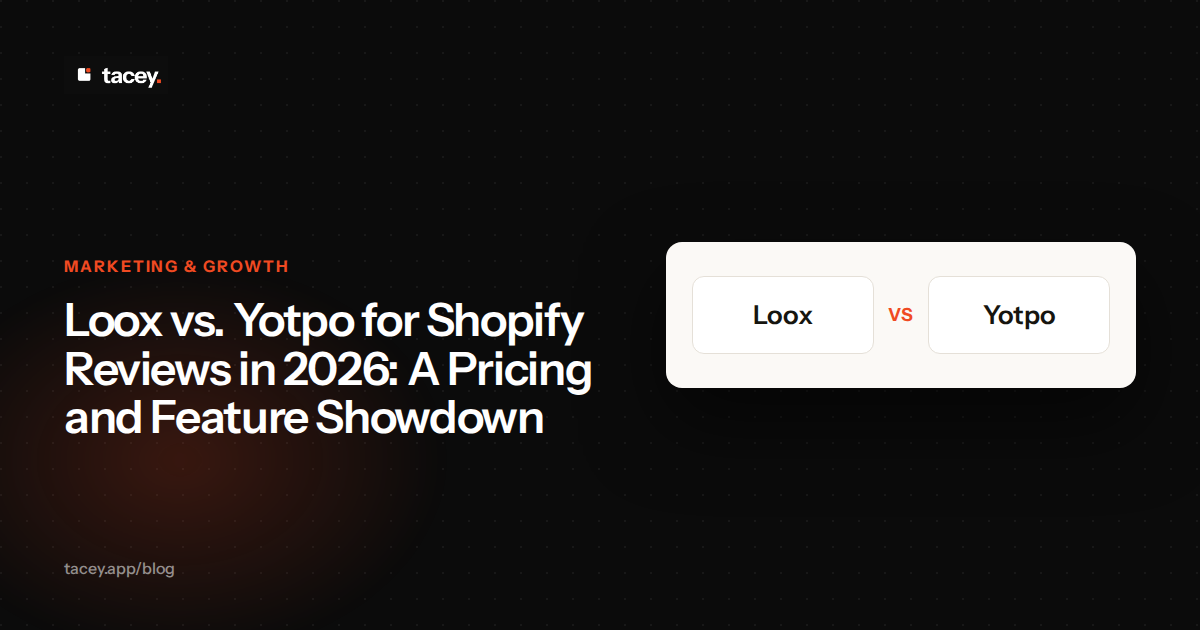
Choosing a review app for your Shopify store is a critical decision. Customer reviews build trust, provide social proof, and directly impact conversion rates. Two of the most prominent names in the space are Loox and Yotpo. While both collect and display reviews, they represent two different philosophies: Loox offers a focused, visual-first tool, while Yotpo provides a comprehensive marketing platform.
For most Shopify stores focused on building trust through visual proof, Loox is often the more direct and cost-effective choice. Yotpo becomes the stronger contender for larger brands that can leverage its entire suite of products, including loyalty and SMS marketing, and are willing to pay for an integrated platform.
What is the main difference between Loox and Yotpo?
The core difference is specialization versus scope. Loox is a dedicated Shopify review app laser-focused on collecting and displaying photo and video reviews. Yotpo is a multi-product marketing platform that includes reviews, loyalty programs, SMS marketing, and user-generated content (UGC) curation.
This distinction shapes everything from their pricing to their user experience. Loox is designed to do one job exceptionally well: generate visual social proof. Its features are built around incentivizing customers to submit photos and videos with their reviews. The setup is generally faster, and the interface is simpler because its purpose is singular.
Consider a brand selling custom-fit apparel. For them, a photo review showing how a garment fits a real person is the most powerful marketing asset they can get. Loox's singular focus on generating that visual content directly serves their primary business need. Its entire feature set is aligned with this goal, making it an efficient choice.
Now, think of a store selling consumer electronics. While reviews are important, visual proof is less critical than for apparel. This merchant may be more concerned with driving repeat purchases for accessories and upgrades. Yotpo's integrated loyalty and SMS platform, which can trigger campaigns based on review activity, offers a more compelling long-term value proposition for this type of business.
Yotpo's approach is to be an all-in-one solution. For a merchant already using or planning to use loyalty programs and SMS marketing, having them integrated with reviews in a single dashboard is a powerful advantage. This breadth, however, brings more complexity and a higher price tag. The choice often comes down to whether you need a best-in-class tool for a specific job or a good-enough suite that handles several jobs at once.
How do Loox and Yotpo's pricing compare in 2026?
Loox and Yotpo use different pricing models, making a direct comparison tricky. Loox has simpler tiers, while Yotpo's pricing is highly dependent on your monthly order volume. As of late 2026, Yotpo has a limited free plan for up to 50 monthly orders, while Loox's free plan covers a store's first 500 lifetime orders.
For paid plans, Yotpo's "Starter" tier begins at $15/month and scales with order volume. Loox's first paid plan, "Convert, " starts at $49.99/month for 300 orders and then charges for additional blocks of orders, which can lead to higher costs for fast-growing stores. For example, a store with 900 orders a month would pay around $149.99 on Loox's Convert plan. Yotpo's equivalent cost depends on the features selected but often involves a conversation with their sales team for higher tiers.
Here is a simplified breakdown of their entry-level and mid-tier offerings:
| Feature / Plan | Loox | Yotpo |
|---|---|---|
| Free Plan | Yes, for first 500 lifetime orders. Photo reviews included. | Yes, for up to 50 monthly orders. No photo/video reviews. |
| Paid Entry Point | $49.99/month (Convert) for 300 orders. | $15/month (Starter), scales with orders. |
| Photo & Video Reviews | Photos on all plans. Video on Convert ($49.99+) plan. | Photos & video on Starter ($15+) plan. |
| Billing Model | Order-based blocks on Convert plan. | Order-based scaling on all paid plans. |
A Worked Example: A Store with Fluctuating Growth
Let's model costs for a hypothetical Shopify store over a three-month period of rapid growth. This illustrates the key pricing trade-off: the predictability of Loox's blocks versus the granular scaling of Yotpo. Assume the store has 250 orders in Month 1, 550 in Month 2, and 850 in Month 3.
On Loox's Convert plan ($49.99 for 300 orders), the cost would be $49.99 in Month 1. In Month 2, with 550 orders, they would need the next tier, which covers up to 600 orders for $99.99. In Month 3, at 850 orders, they'd jump to the 900-order tier at $149.99. The total cost over three months is $299.97. The cost per order fluctuates significantly.
On a comparable Yotpo plan, the scaling is more linear. Let's assume a plan that costs around $119 for 800 orders. Month 1 (250 orders) might cost $39. Month 2 (550 orders) might cost around $79. Month 3 (850 orders) would be slightly above the 800-order tier, costing approximately $129. The total over three months is $247. The cost per order remains more stable.
The trade-off is clear. Loox provides feature-rich plans at set price points, but growth can push you into a new, more expensive block, even if you only exceed the limit by a few orders. Yotpo's model can be more cost-effective during growth, but its feature set at each price point is different. This requires merchants to weigh cost predictability against feature access.
Which app is better for collecting photo and video reviews?
Loox is purpose-built for collecting visual reviews and generally excels in this area. Its entire workflow is optimized to encourage customers to upload photos and videos, including offering discounts as an incentive. This focus often results in a higher volume of visual user-generated content for merchants.
A concrete step in Loox is setting up a tiered incentive. You might offer a 10% discount for any review, but increase it to 15% if the customer includes a photo. This is a powerful lever. The app automates sending the unique discount code after the review is submitted, making the process seamless for the merchant.
This does, however, introduce a direct cost. If 100 customers submit a photo review for a $50 product, that 15% discount costs you $750 in potential margin. The trade-off is whether the social proof from those 100 photos will increase your conversion rate enough to offset that cost. If it doesn't, or if the photos are low quality, the strategy can backfire by eroding profitability.
Yotpo also supports photo and video reviews, and notably, it offers video reviews on its cheaper "Starter" plan, which starts at $15/month. Loox, by contrast, gates video reviews to its "Convert" plan, starting at $49.99/month. So, if video is a must-have on a tight budget, Yotpo has a slight edge on price.
However, for overall visual content strategy, from collection to display, Loox's specialized widgets and galleries are often considered more robust and aesthetically focused. The choice depends on whether you prioritize getting the feature for the lowest price (Yotpo) or maximizing the quantity and quality of visual reviews (Loox).
What are Yotpo's advantages as a full marketing platform?
Yotpo’s main advantage is its integrated suite of marketing tools. For a merchant who wants reviews, loyalty, referrals, and SMS marketing to work together from a single dashboard, Yotpo is the clear winner. This consolidation can simplify workflows and create a more unified customer data layer.
By connecting these functions, a store can create more sophisticated campaigns. For example, you can reward loyalty points for leaving a review, then follow up via SMS with a special offer. This synergy is something a standalone reviews app like Loox cannot offer natively. Loox integrates with loyalty and email apps like LoyaltyLion, Klaviyo, and Omnisend, but it's not the same as having a single-vendor solution.
Here is an edge case where Yotpo becomes the only logical choice: multi-channel retail. Imagine a brand that sells direct-to-consumer on Shopify but also has a wholesale business with major retailers like Target or Best Buy. Yotpo's enterprise plans offer review syndication, which pushes reviews collected on Shopify to retail partner websites.
This capability is a game-changer. It ensures product pages on Target.com show the same rich social proof as the brand's own website. Loox, as a Shopify-centric tool, has no mechanism for this. For brands where offline and third-party retail are a significant part of their strategy, Yotpo's platform scope is a non-negotiable advantage.
Yotpo also offers deeper integrations for enterprise-level needs, such as syndication to retail partners and more advanced API access on its higher-tier plans. For large, multi-channel brands, this platform approach is often worth the higher price and complexity.
Why do merchants choose Loox for its simplicity?
Merchants choose Loox when their primary goal is to quickly and effectively add compelling visual reviews to their store. Its focus on a single job makes it faster to set up and easier to manage than a multi-faceted platform like Yotpo. For a small team or a solo entrepreneur, this simplicity is a significant advantage.
The user interface is clean and intuitive, guiding merchants through the process of customizing widgets and setting up automated review request emails. Because it is a Shopify-only app, its integration with the platform is deep and seamless. You can manage most functions without feeling like you're juggling a complex new system.
This simplicity translates into a lower total cost of ownership. The cost of an app isn't just its monthly subscription; it's also the human hours required to operate it. A small team might spend ten hours a month learning and managing Yotpo’s interconnected loyalty, SMS, and review features. The same team might only spend two hours on Loox. Those saved eight hours are real money that can be invested elsewhere.
This simplicity extends to its feature set. While Yotpo offers a vast array of options that can sometimes be overwhelming, Loox presents a curated set of tools designed for maximum impact with minimal configuration. If you want to "set it and forget it" while still getting beautiful, conversion-driving photo reviews, Loox is a strong choice.
Which app has better AI features for summarizing reviews?
Both Loox and Yotpo have invested heavily in AI to help shoppers digest review content. Both platforms offer features that automatically summarize reviews, identify key topics, and allow customers to filter feedback based on specific attributes like "fit" or "quality."
Yotpo's AI engine, which powers features like "AI Reviews Summary" and "Smart Filters, " leverages a massive dataset to identify trends and summarize feedback. These tools are designed to help shoppers make faster, more informed decisions by highlighting the most relevant information. The AI summary feature is available on its Pro plan and higher.
Loox offers a similar suite of AI tools on its Convert plan, including "AI Review Summaries, " "AI Review Replies, " and "Smart Filters." Loox's "AI Review Stories" feature even packages insights into a tappable, social-media-style format. For a shopper, this means they can filter for reviews from customers with a similar body type, then read an AI summary that says, "Many reviewers note the fabric is comfortable, but recommend sizing up for a looser fit."
Ultimately, both apps provide powerful AI capabilities. The choice may come down to which plan you're on, as these features are typically not available on the free or lowest-priced tiers. The true value is in how effectively they turn thousands of words of customer feedback into a quick, trustworthy signal for the next buyer.
Can you migrate reviews from Loox to Yotpo (or vice-versa)?
Yes, you can migrate reviews between Loox, Yotpo, and other Shopify review apps, but the process is manual. Reviews are stored by the app, not by Shopify, so you must export your reviews from the old app and import them into the new one. This is typically done using a CSV file.
The process generally involves a few key steps. First, export all your reviews from your current app, it is crucial to do this before uninstalling it, or you may lose the data. Next, install the new app. Then, using the new app's import tool, you upload the CSV file and map the data columns (like reviewer name, rating, and review text) to the new app's format.
However, this process carries significant risk if done incorrectly. The cost of a failed migration is catastrophic. If the product IDs in your export file do not perfectly match the product IDs in your store, you could end up with reviews for a t-shirt appearing on a coffee mug page. This instantly destroys customer trust and can lead to a spike in returns.
An even greater risk is losing your visual content. Often, the CSV file contains only URLs to the photo and video assets, which are hosted by the old app. If you uninstall the old app before confirming the new app has successfully copied the images, those links can break forever. Years of carefully collected social proof can vanish in an instant, potentially devastating your conversion rates.
It is important to ensure product identifiers (like SKU or product ID) match between the export file and your current product catalog to link reviews correctly. While the text and ratings usually transfer smoothly, migrating photos and videos can sometimes be more complex. It's always best to follow the specific import documentation provided by your new app provider.
The trust you build with authentic reviews is the perfect foundation for a stronger customer relationship. Once a shopper is convinced, the moments after they buy are your best chance to increase their lifetime value.
After a customer trusts your brand enough to make a purchase, thanks in part to compelling reviews from Loox or Yotpo, the journey isn't over. The order confirmation page represents a moment of high engagement. This is an ideal opportunity to increase average order value and customer satisfaction. By using a tool like Tacey, you can offer a relevant complementary product through its Recommended for you row, or a free gift, directly on the order status page.
This capitalizes on the customer's buying momentum without disrupting the original checkout flow. Explore how a free gift and Recommended for you row can turn the trust you've built into greater revenue by trying Tacey on the Shopify App Store.
Frequently asked questions
Is Yotpo's free plan good enough to start with?
Yotpo's free plan is a viable starting point for new stores processing fewer than 50 orders per month. It allows you to collect text-only reviews automatically and display them on-site. However, it lacks key features like photo/video reviews and removal of Yotpo branding, which are essential for many brands.
Do review apps like Loox or Yotpo slow down my store?
Any third-party app can potentially impact site speed. Both Loox and Yotpo have built their widgets to be as lightweight as possible. However, loading many high-resolution images or videos in review galleries can affect page load times. It's good practice to monitor your site's performance after installing any new app.
Which app is better for Google Shopping integration?
Both Loox and Yotpo offer integration with Google Shopping on their paid plans, allowing your star ratings to appear in product listings. Yotpo, through its official partnership with Google, also supports Google Seller Ratings, which apply to your store as a whole, though this is typically on higher-tier plans.
Can I customize the look of the review widgets?
Yes, both apps offer extensive customization options for their widgets. You can change colors, fonts, and layouts to match your brand's aesthetic. This ensures that the reviews feel like a native part of your site rather than a tacked-on, third-party element.
What happens to my reviews if I switch Shopify themes?
Your reviews are tied to the review app, not your theme. When you switch themes, you will need to re-install the app's widgets into the new theme. The process is usually straightforward, involving adding the app's blocks or snippets through the Shopify theme editor. Your actual review data will remain safe within the app itself.
 Install on Shopify