 tacey
 Install on Shopify

Affiliate marketing is one of the most effective ways to grow your Shopify store without a massive upfront ad spend. You partner with creators, publishers, and even loyal customers who promote your products, and you only pay them when they drive a sale. It’s a performance-based model that can build brand credibility and a steady stream of new customers.
But managing the tracking, commissions, and payouts can quickly become a major operational headache. That's where a dedicated Shopify affiliate app comes in. These tools automate the entire process, from recruiting partners to paying them accurately and on time. While Tacey does not offer an affiliate marketing tool, this guide will help you choose the right app for your store. This article compares the nine best options available in 2026.
| Best For | App Pick | Pricing Starts At |
|---|---|---|
| New stores on a budget | GoAffPro | $0/month (Free Plan) |
| Growing stores that need scalability | UpPromote | $0/month (Free Plan, limits apply) |
| Flat-fee pricing with no percentage cut | ShoutOut | $39/month |
| Established brands needing deep tracking | Refersion | $39/month + 3% of sales |
| Automating customer-to-affiliate funnels | Social Snowball | $249/month + 3% of revenue |
| All-in-one creator & ambassador platforms | Roster | $725/month |
What should I look for in an affiliate marketing app for Shopify?
You should look for an app that offers reliable tracking, flexible commission options, and a user-friendly dashboard for your affiliates. The right tool depends on your budget and scale. Key features include accurate sales attribution through links and coupon codes, support for different commission structures, and automated, timely payouts to keep partners motivated.
Poor tracking costs you real money. Imagine two affiliates claim credit for the same $200 sale. Without clear attribution rules, you might pay a commission twice, turning a profitable order into a loss. This is why reliable link and coupon tracking isn't just a feature; it's the foundation of a sustainable program that maintains trust with your partners.
This is a common attribution conflict. Most apps default to "last-click" attribution, crediting the final link a customer clicked before buying. But some let you choose "first-click" to reward the affiliate who introduced the customer. Your choice defines who you reward: the introducer or the closer. Be explicit about your model in your program terms to avoid disputes.
A great affiliate app should also provide a branded portal where your partners can see their performance metrics, grab promotional materials, and access their unique tracking links. As your program grows, features like fraud detection, multi-level marketing (MLM) capabilities, and integrations with your email marketing stack become increasingly important for managing your network effectively.
How do different apps handle affiliate commission structures?
Most affiliate apps support several commission models, allowing you to choose what best fits your business. The most common is a percentage of the sale, but others include flat-rate payments per sale, recurring commissions for subscriptions, and tiered rates that reward top performers with higher percentages as they drive more revenue.
Percentage-based commissions are popular for ecommerce because they scale with the order value. Flat-rate commissions offer predictability, which is useful for lead generation. Recurring commissions are essential for subscription-based businesses to incentivize long-term customer loyalty. Apps like UpPromote, Refersion, and ShoutOut provide the flexibility to create these different structures, sometimes even allowing product-specific commission rates.
The Cost of Returns: Commission Clawbacks
What happens if an affiliate-driven sale gets returned? If you pay commissions instantly, you lose that money. To prevent this, good affiliate apps have a "commission locking period." This feature holds the commission for 30 or 60 days, matching your return window. The commission is only paid out after the return period has safely passed.
This is a critical step for protecting your profit margins. Before paying out, you must reconcile your sales against any refunds. Manually, this is a nightmare. An app that automates commission holds and adjustments for returns saves hours of administrative work and prevents you from paying for sales that didn't stick, which is crucial for program profitability.
Which apps offer the best dashboards for affiliates to track their performance?
The best apps provide clean, branded dashboards where affiliates can easily monitor their clicks, conversions, and earnings in real time. UpPromote and GoAffPro are frequently praised for their intuitive and customizable affiliate portals. These dashboards give partners access to their unique referral links, coupon codes, and any creative assets you provide.
A confusing dashboard creates doubt and extra work. If an affiliate cannot see where their clicks are coming from or why a sale wasn't credited, they will stop promoting you. Or, they will flood your inbox with support questions, distracting you from growing the business. Their trust in your program depends on clear, real-time data they can access easily.
Before you choose an app, ask for a tour of the affiliate's view. Many sales demos only show the merchant's admin panel. You need to see what your partners will see every day. Is it clean? Is it mobile-friendly? Can they easily grab their link and see their earnings? This perspective is crucial for recruitment and long-term affiliate retention.
A strong dashboard is crucial for affiliate engagement and trust. It should clearly display performance analytics, payment history, and program terms. Advanced platforms like Refersion also offer deep reporting within their dashboards, giving affiliates the data they need to optimize their promotional strategies. The goal is to provide transparency and make it as easy as possible for partners to promote your brand successfully.
Are there apps that charge a flat monthly fee instead of a percentage of sales?
Yes, several apps charge a flat monthly fee without taking a percentage of affiliate-generated sales. GoAffPro, BixGrow, and ShoutOut are prominent examples. This pricing model offers predictable costs, which can be highly advantageous for stores with high sales volume, as your app subscription fee doesn't increase as your affiliate program succeeds.
In contrast, many other popular apps like UpPromote, Refersion, and Social Snowball use a hybrid model. They charge a monthly subscription fee plus a percentage of the sales driven by affiliates. While their entry-level subscription might seem lower, the percentage-based fee can become a significant cost as your program scales. Always calculate your potential costs based on projected affiliate sales before choosing a platform.
A Worked Example: Calculating Total Cost
Let’s run the numbers for a store with $10,000 in monthly affiliate sales. With a flat-fee app like ShoutOut at $39/month, your cost is just $39. With a hybrid app like Refersion at $39/month plus a 3% fee, your cost is $39 plus $300 (3% of $10k). That’s $339 per month. The difference is significant and grows with your sales.
The trade-off is features versus cost at scale. Hybrid-fee apps often justify their percentage cut with more advanced analytics, enterprise-level support, or deeper integrations. For a new store, a flat-fee app provides cost certainty and is often the safer choice. For a large brand, the extra cost of a percentage fee may be worth it for the powerful tools included.
How do top affiliate apps handle coupon code tracking?
Top affiliate apps attribute sales by assigning a unique discount code to each affiliate. When a customer uses that code at checkout, the app automatically credits the sale to the corresponding partner. This method is highly reliable because it doesn't depend on browser cookies, which can be cleared or blocked.
This "clickless" tracking is crucial for influencers on platforms like TikTok and Instagram, where sharing a simple code is easier than a long link. Apps like UpPromote, GoAffPro, and Refersion all offer robust coupon code tracking. Some, like Social Snowball, even specialize in generating unique codes for every customer post-purchase, turning them into potential affiliates instantly. The best systems use both link and coupon tracking together for maximum accuracy.
The Attribution Conflict Edge Case
Here is a common problem. A shopper clicks Affiliate A's review link, but hesitates. Later, they find a 10% discount code from Affiliate B on a coupon site and use it to complete the purchase. Who gets the commission? The link click or the coupon code? This creates an attribution conflict that can lead to disputes between your partners.
Your app's settings and program terms must provide the answer. Many platforms let you prioritize one method over the other, or default to a last-touch model. For example, you can set the rule that a coupon code always overrides a previous link click. Whatever you decide, state it clearly in your affiliate agreement to prevent arguments and ensure fair payment.
What's the process for recruiting and approving new affiliates?
Most affiliate apps streamline recruitment with a customizable, branded signup page that you can host on your site. Prospective affiliates fill out an application, which you can then review and approve or deny from your app's dashboard. Apps like UpPromote also feature a marketplace where you can list your program to attract new partners.
How to Vet an Affiliate Applicant
Not all applicants are good partners. Before approving someone, take five minutes to vet them. Look at their website or social media profile. Is their content professional and aligned with your brand's values? Do they have a real, engaged audience, or just inflated follower counts with no comments or shares? A mismatch can harm your brand's reputation.
The biggest risk is the coupon code spammer. These affiliates create low-effort websites that only list discount codes. They don't create content or drive new customers. They just capture sales from people who were already about to buy. Approving them means you pay commissions on sales you would have earned anyway, directly hurting your profitability.
Once approved, affiliates get access to their dashboard and unique tracking assets. Many apps, including GoAffPro and ShoutOut, allow for unlimited affiliates even on their entry-level plans. For a more automated approach, Social Snowball can automatically enroll every customer into your affiliate program right after they complete a purchase, creating a powerful word-of-mouth engine.
Which apps make it easiest to provide creative assets to affiliates?
Most leading affiliate apps, including UpPromote, Refersion, and GoAffPro, include a feature for managing creative assets. You can upload banners, product images, logos, and pre-written copy directly into the affiliate dashboard. Your partners can then easily access and download these materials to use in their promotions, ensuring brand consistency.
To truly empower your affiliates, go beyond just logos and banners. Provide them with a "brand kit" that includes your official fonts, color codes, and tone-of-voice guidelines. This helps high-effort partners create content that feels like a natural extension of your brand, building more trust with their audience and improving conversion rates.
Also include specific, campaign-ready assets. For a new product launch, give them pre-written email copy, social media captions, and high-resolution lifestyle photos. For a holiday sale, provide themed banners and talking points. Keeping your creative library fresh gives affiliates a reason to keep promoting you, month after month, and drives better results.
This centralized library saves time for both you and your affiliates. Instead of emailing files back and forth, partners have a self-serve portal for all their promotional needs. This makes it easier for them to create high-quality content that aligns with your brand guidelines, ultimately leading to more effective campaigns.
How do the top Shopify affiliate apps compare on pricing and features for 2026?
The top apps are differentiated by their pricing models and target users. GoAffPro is the best free option, offering unlimited affiliates and sales with no monthly fee, making it ideal for new stores. UpPromote offers a more feature-rich experience with a free plan for up to $3,000 in monthly referral sales, but its paid plans add a percentage fee on top of the subscription. Refersion is geared toward established brands, justifying its higher price ($39/month + 3% of sales) with superior tracking and support.
Beyond the sticker price, consider the hidden costs. A "free" app might lack the fraud detection tools needed to stop you from paying for fake sales. This costs you money. A cheaper app may also lack direct payout integrations, forcing you to spend hours each month manually sending PayPal payments to dozens of affiliates. This costs you time.
For those who prefer predictable costs, ShoutOut and BixGrow offer flat monthly subscriptions with no percentage fees. Social Snowball targets creator-led brands with its automated customer-to-affiliate workflow but comes at a premium starting price of $249/month plus a 3% revenue share. Your choice depends on your budget, sales volume, and whether you want a simple tool or a comprehensive partnership platform.
Can I run an affiliate program and a referral program at the same time?
Yes, you can absolutely run both programs simultaneously, and many apps are designed to manage both. Apps like BixGrow and ShoutOut combine affiliate and referral program management in a single interface. This allows you to reward professional marketers and influencers through a formal affiliate program while also incentivizing loyal customers to refer their friends.
The reward structure should also be different. Affiliate programs are business partnerships, so they should pay in cash. This allows creators and publishers to treat it as a real revenue stream. Referral programs, however, are for loyal customers. Rewarding them with store credit or discounts encourages them to make another purchase, boosting retention and lifetime value.
The distinction is important: affiliate programs are typically for marketers aiming to earn income, while referral programs reward existing customers for sharing with their personal network. Using an app that supports both, like ReferralCandy or BixGrow, helps you leverage both channels for growth without the complexity of using separate tools. For more on this, see our roundup of the best Shopify referral apps.
Every sale is a promise. The real work starts after the payment, in making sure that promise is kept efficiently and the customer leaves happy.
An affiliate program is a powerful engine for acquiring new customers. However, the profitability of those new sales depends on what happens after checkout. A simple mistake, like a typo in a shipping address, can lead to a failed delivery, a support ticket, and an unhappy customer. These post-purchase issues create costs that eat into the margin of that hard-won sale.
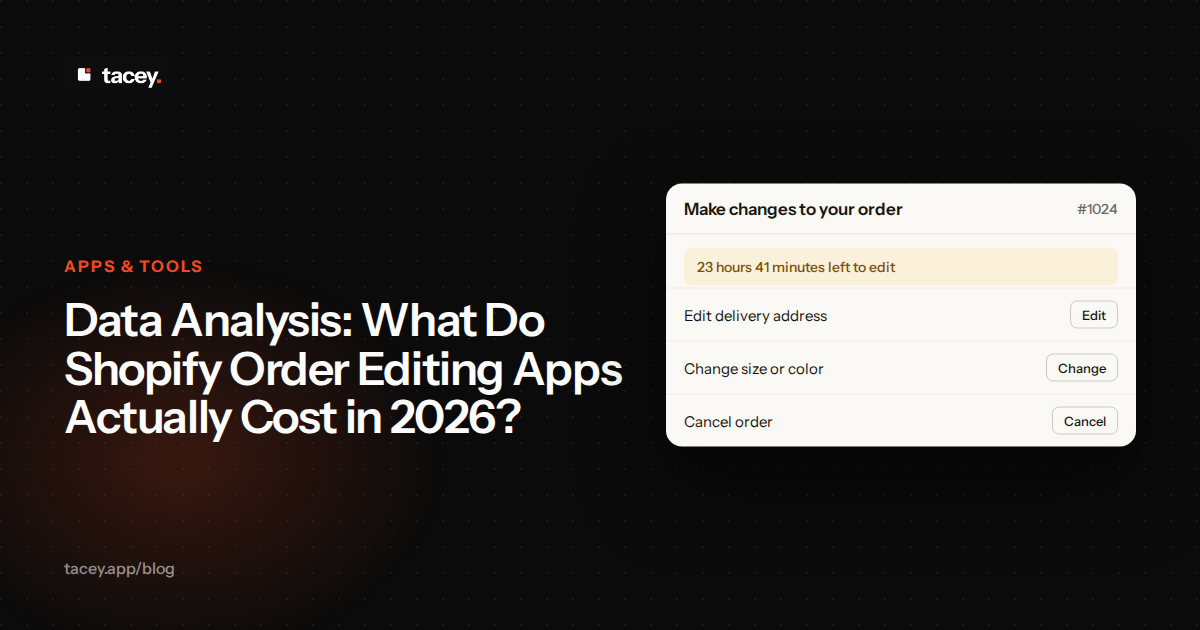
Tacey helps protect your profitability by giving customers the power to fix their own common order mistakes. After paying, customers can use Tacey on the order status page to correct their shipping address, update contact information, or even change a product size before the order ships. This self-service capability reduces support tickets and minimizes costly shipping errors.
By integrating Tacey, you ensure that the new customers your affiliates bring in have a smooth experience from day one. Learn more about how you can empower your customers with Tacey's order editing tools or install it today from the Shopify App Store.
Frequently asked questions
What is the best free affiliate app for Shopify?
GoAffPro is widely considered the best free option because its free plan includes unlimited affiliates, unlimited sales, and a branded affiliate portal without a monthly fee. UpPromote also offers a strong free plan, though it has limits on monthly referral sales.
How much commission should I pay Shopify affiliates?
Commission rates typically range from 5% to 30% of the sale value. The right percentage depends on your product margins, industry, and customer lifetime value. Digital products and SaaS can often offer higher rates than physical goods due to lower fulfillment costs.
Do I need an app for a Shopify affiliate program?
While you could technically manage a small program with spreadsheets and manual discount codes, it's not practical. An app automates tracking, commission calculations, and payouts, which saves a significant amount of time and prevents costly attribution errors that can damage relationships with your partners.
What's the difference between an affiliate and a referral program?
An affiliate program is a formal partnership with marketers, influencers, or publishers to drive sales in exchange for a commission. A referral program typically incentivizes your existing customers to share your products with friends and family, often for store credit or a smaller reward.
How do affiliates get paid?
Most affiliate apps facilitate payments through integrations with platforms like PayPal or via direct bank transfers. Some apps offer automated mass payouts, allowing you to pay all of your affiliates at once with a single click. The merchant is always responsible for funding these commissions.
Does Shopify have its own affiliate program app?
Shopify offers an app called Shopify Collabs, which is designed to connect brands with creators. However, most merchants opt for third-party apps like UpPromote or GoAffPro due to their more extensive feature sets, flexible pricing, and established track records in affiliate management.
 Install on Shopify