 tacey
 Install on Shopify

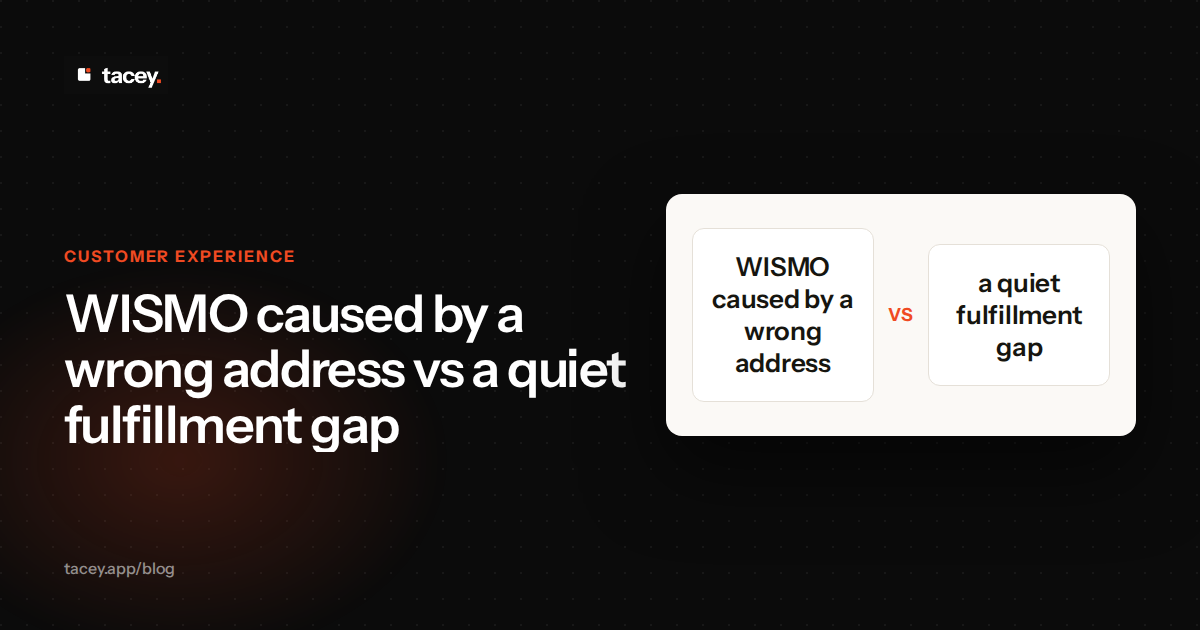
Most Shopify stores treat all "Where is my order?" (WISMO) tickets as the same problem. They are not. One is a simple data entry mistake that happens before you ship, while the other is a communication breakdown that happens after. Solving one with the other's tool wastes time and money, and leaves the customer frustrated.
What are the two kinds of where-is-my-order tickets?
The two kinds of WISMO tickets are pre-fulfillment questions and post-fulfillment questions. Pre-fulfillment tickets are about errors in the order itself, like a wrong address. Post-fulfillment tickets are from customers who have a shipped order but lack clear tracking information.
A pre-fulfillment WISMO is really a "Where is my order going?" ticket. The customer has noticed a typo in their shipping address or chosen the wrong size. They are worried the order will ship incorrectly. This problem is about correcting data on a paid order before it leaves your warehouse.
The customer feels a sense of immediate panic. They have just spent money, but now they see a mistake that could send their purchase to the wrong place. This anxiety is directed at the order details. They know the package has not shipped yet, and their goal is to fix the error before it is too late.
A post-fulfillment WISMO is the classic "Where is my order now?" ticket. The order details are correct and the package is in transit. The customer is asking because they cannot find, or do not understand, the tracking information. This is a communication and expectation-setting problem, not an order data problem.
Here, the customer feels a sense of being forgotten. The initial excitement of their purchase fades into silence. They have a tracking number, but it provides no new information. This creates doubt about whether the package is actually on its way, eroding trust in your brand's reliability.
Which are address errors fixable before the order ships?
Address errors are the most common type of WISMO ticket that is fixable before an order ships. These happen when a customer enters an incorrect house number, misspells a street name, or forgets their apartment number. These mistakes are often caught by the customer themselves shortly after they see the order confirmation.
These tickets represent a window of opportunity. The customer has identified the error, and the package is still in your possession. The fix is a simple data change in your Shopify admin. If the customer can make this change themselves on their order status page, the ticket is prevented entirely.
This window's length depends on your fulfillment speed. If you have a highly automated warehouse that ships orders in hours, the window is very short. For merchants with a one or two-day processing time, there is more time to catch and correct these errors. Understanding your own fulfillment latency is key to managing this opportunity.
This category also includes other pre-fulfillment mistakes, like ordering the wrong size or color. The customer's anxiety is the same: they fear an incorrect item will be shipped. Allowing them to correct their own mistake on the order status page resolves this anxiety and avoids a costly return.
The cost of a single returned package
Failing to fix an address error leads to a returned package. This is not a small cost. The all-in expense of a single return, including shipping both ways, inspection labor, and restocking, can range from 30% to 66% of the item's price. For a €40 product, that is a €12 to €26 loss.
These costs are often hidden, spread across different parts of your business. You see the return shipping fee, but you might miss the labor cost of your warehouse team processing it. You also lose the non-refundable fee from the original payment. Two returns can easily erase the profit from six or seven successful sales.
The damage extends beyond that single transaction. A poor delivery experience can trigger negative reviews, which deter new customers. Acquiring a new customer costs 5 to 25 times more than retaining an existing one. That failed delivery does not just cost you a sale; it creates a hidden, long-term marketing expense to replace that lost customer.
Which come from silence after fulfillment?
WISMO tickets that come from silence after fulfillment are born from an information vacuum. The customer receives a shipping confirmation email, clicks the tracking link, and finds the status is "Label Created" for days. They have no visibility into when their package will actually move, so they contact support.
These issues are not about incorrect data. The customer's address is right and the right products are in the box. The problem is a gap between your fulfillment team printing a label and the carrier performing the first scan. This gap can be hours or days, and during that time, the customer is in the dark.
The "Speed vs. Communication" Trade-off
Merchants often print shipping labels in batches to streamline their workflow. This feels efficient, but it can create an artificial information gap. A label might be printed on a Friday, but the carrier pickup is not until Monday. For 48 hours, the customer sees no progress, and their anxiety grows.
This is a classic trade-off between operational speed and customer communication. By prioritizing batch printing for internal efficiency, you may be sacrificing your customer's peace of mind. The perceived lack of movement makes customers think their order is lost, leading directly to a post-fulfillment WISMO ticket.
The real reason for batch printing is labor savings. Processing 500 labels might take four hours manually but only 10 minutes with a batch system. This efficiency allows a small team to handle high order volumes. However, this saving is partially offset by the new costs it creates in customer support.
Each WISMO ticket generated from this fulfillment gap carries a real cost. For e-commerce, the average cost to handle a single support ticket can range from €6 to €16. The labor saved in the warehouse is now being spent by your support team answering questions that proactive communication could have prevented.
During peak seasons, this problem gets worse. Carrier networks are strained and scans can be delayed. A customer sees no movement and assumes their order is lost or forgotten. Support ticket volumes can increase by 200-500% during these periods, with WISMO inquiries often accounting for over 50% of the total.
Why do they need different fixes?
They need different fixes because the root causes are entirely separate. You cannot solve a data entry problem with a tracking page, and you cannot fix a communication gap with an order editing tool. Applying the wrong solution leads to more work for your team and more frustration for your customers.
An address error requires an edit to the order data. The best solution is one that allows the customer to make the correction themselves, instantly, on the post-purchase order status page. This removes your support team from the process entirely. A better tracking page does nothing to fix the wrong apartment number.
Applying the wrong fix is costly. If you send tracking updates for an order with a bad address, the package will eventually be returned to you. Now you have paid for a support ticket, two-way shipping, and still have an unhappy customer with no product. The problem has multiplied.
A post-fulfillment silence problem requires proactive communication. The solution involves sending timely updates about shipping progress, especially if there are known delays. An order editing tool is useless here because the order has already shipped. The window to change the order's contents or destination is closed.
To diagnose the issue quickly, your support agents need the right tools. They should not have to toggle between Shopify, a carrier's website, and your warehouse software. A unified dashboard that shows order data, fulfillment status, and live tracking in one view is essential. This concrete step reduces handling time and enables a faster, more accurate first reply.
| WISMO Type | Root Cause | Incorrect Solution | Correct Solution |
|---|---|---|---|
| Pre-Fulfillment (Address Error) | Incorrect data on the order | Sending more tracking updates | Allowing customer to edit address on order status page |
| Post-Fulfillment (Shipping Silence) | Lack of communication during transit | Offering an order editing window | Proactive, clear shipping notifications |
How do you tell them apart in your inbox?
You can tell the two WISMO types apart by the specific language the customer uses in their support ticket. Look for keywords that point to either a data error or a request for a status update. This initial diagnosis is the key to routing the ticket correctly or, better yet, preventing it in the future.
Pre-fulfillment tickets often contain phrases like "wrong address," "forgot my unit number," "oops," or "can I change." The customer is admitting a mistake and asking for a correction. They are focused on the order details, not the carrier's performance. These are your cue to look for a data entry problem.
The Ambiguous Edge Case
What about a ticket that just says, "Where's my order?" This is an edge case that breaks the simple keyword rule. It could mean anything. The first step for a support agent is to check the order status. Has it shipped? If not, the agent should check the address for obvious errors. If it has shipped, the agent should check the tracking.
This triage process is a concrete step your team must take. Create a simple flowchart: if the ticket is ambiguous, first check fulfillment status. This determines which branch of the flowchart to follow next. This manual process, however, highlights the value of preventing the ticket in the first place.
A misdiagnosis at this stage is costly. If an agent assumes an ambiguous ticket is about shipping and sends a generic tracking link, they fail to address the actual problem of a bad address. The customer feels ignored, and the ticket resurfaces days later when the delivery fails. This creates a second, more frustrated interaction and doubles the support cost for that single order.
Post-fulfillment tickets use phrases like "tracking not updated," "still says label created," or "has it shipped yet?" The customer is asking for information about the package's journey. They are not questioning the order's accuracy. These tickets point directly to a gap in your shipping communication.
What should you change first?
The first and most effective change is to reduce the number of orders that ship with bad addresses. Instead of waiting for the customer to spot their own mistake, proactively ask them to double-check their details before your fulfillment process begins. This single step can prevent a huge number of pre-fulfillment WISMO tickets.
The timing of this communication is critical. The ideal moment for this check is right after the order confirmation email but before the order enters your fulfillment queue. Sending an automated email at this point creates a natural "last chance" for the customer to act while the purchase is still top-of-mind. This prevents errors without disrupting warehouse operations.
This is not about simply validating the address for deliverability. It is about confirming the address with the one person who knows for sure if it is correct: the customer. An automated email that asks "Is this where you want your order sent?" can prompt a customer to fix a typo they might have otherwise missed.
Here is a concrete step you can take this week. Open your last 30 days of orders and filter for returns marked as undeliverable or address-related. Count them. Then check how long each order sat between payment and label printing. If most errors were caught in under 24 hours, your window is short and your reminder should go out within an hour of purchase.
A Worked Example with Real Numbers
Imagine you ship 2,000 orders per month. If just 1% have address errors that lead to a return, that is 20 failed shipments. A single WISMO ticket costs about €4, and the all-in cost of a returned package can be €20. That means each error costs you €24. Your monthly cost for this "small" problem is €480, or €5,760 per year.
Now, consider the return on investment for a tool that prevents these errors. If a pre-shipment reminder system costs €50 per month and eliminates 80% of these address errors, you save €384 for a €50 investment. That is a return of over 600%, not counting the saved support time and improved customer trust.
By bringing the customer back to their order status page while the edit window is still open, you give them the power to prevent the problem. This approach turns a potential support ticket and a possible returned package into a positive, self-service interaction that builds trust.
A support ticket is a record of a system that failed. The best ticket is the one that was never created because the customer solved the problem themselves, moments after it happened.
For Shopify merchants, the most direct way to implement this is with a tool that sends pre-shipment reminders. Tacey's pre-shipment reminder feature allows you to do exactly this. You can set up automated emails that ask customers to confirm their shipping address before the order is fulfilled.
These reminders are off until you switch them on. You control when they are sent and how many go out. The emails bring the customer directly to their Shopify order status page, where they can correct any mistakes themselves if you have customer editing enabled. This simple, proactive step reduces address-related WISMO tickets by solving them before they happen. See what Tacey can do for your store by starting a free 14-day trial.
Frequently asked questions
How much do WISMO tickets cost a business?
The cost of a single WISMO ticket can be around €4, according to some benchmarks. This figure does not include the cost of a returned package, a replacement shipment, or the potential loss of a customer due to a poor experience. The full cost of an address-related WISMO can be much higher, with some estimates for a single returned package reaching €20-€30.
Can customers fix their own address on Shopify after purchase?
By default, customers cannot edit their shipping address after an order is paid on Shopify. However, apps like Tacey can add this functionality to the order status page, allowing customers to correct their own address within an edit window you define. Setting a realistic edit window based on your fulfillment schedule is critical to making this feature work.
Do pre-shipment reminders annoy customers?
When framed as a helpful double-check, customers generally appreciate pre-shipment reminders. The goal is to prevent a delivery problem, which is a shared interest. A single, polite email asking to confirm the shipping address is seen as good customer service, not spam. The key is clear, concise language that emphasizes the mutual benefit.
What's the difference between an address validation tool and a pre-shipment reminder?
An address validation tool checks an address against a postal database to see if it is real. A pre-shipment reminder asks the actual customer if the address is where they want the package sent. A valid address can still be the wrong address. For example, a customer might enter their old address by mistake; the address is valid, but the package will go to the wrong place. Only the customer can catch that error.
Will stopping WISMO tickets improve my customer retention?
Reducing WISMO tickets, especially by empowering customers, can improve retention. A poor delivery experience is a top reason for customers not to order again; 85% of shoppers say they won't return after a bad delivery. A smooth, transparent post-purchase experience builds the trust and confidence that leads to repeat business.
 Install on Shopify