 tacey
 Install on Shopify

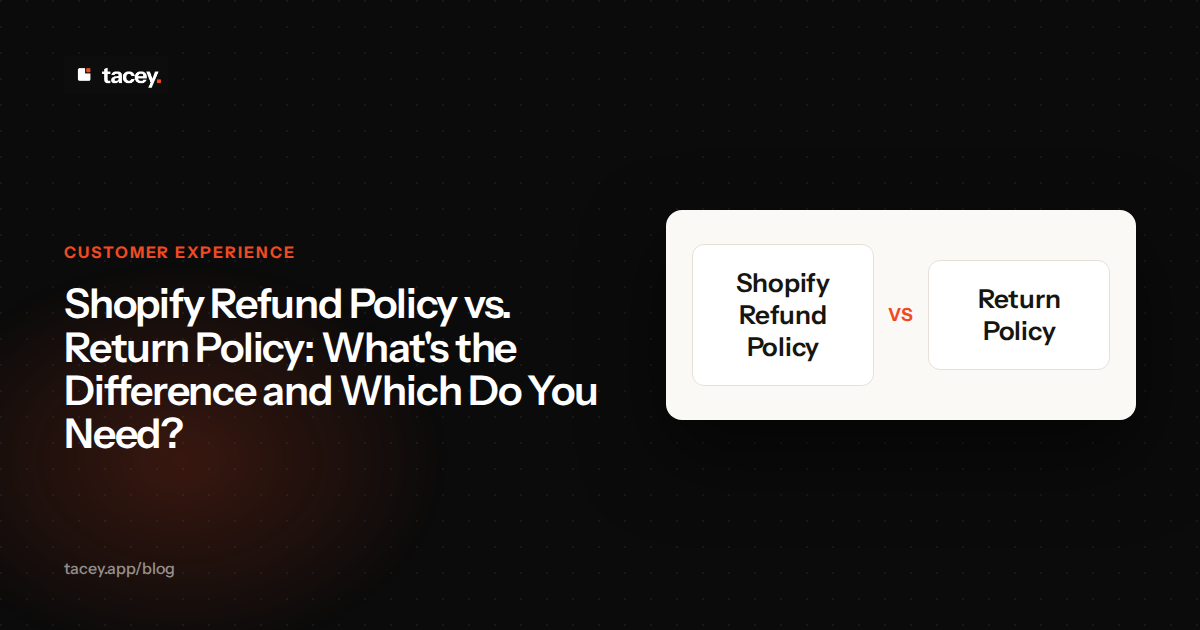
A return policy and a refund policy are not the same thing, though merchants often use the terms interchangeably. A return policy governs if and how a customer can send a physical item back to you. A refund policy explains what happens to the customer's money after a return is accepted or an order is cancelled. Understanding the difference is key to writing clear rules that build trust and reduce disputes.
Most Shopify stores need both policies, and they should work together without contradiction. A clear, fair, and easy-to-find policy is a major factor in a customer's decision to buy, with many shoppers checking the rules before committing to a purchase. This article explains the distinction, how to set up your policies in Shopify, and what each one needs to cover.
What is the legal distinction between a refund policy and a return policy?
The legal distinction is that a return policy deals with the physical goods, while a refund policy deals with the financial transaction. A return policy outlines the conditions for sending an item back, such as the timeframe and required condition. A refund policy dictates the terms under which money will be returned to the customer.
In many regions, consumer protection laws grant customers specific rights. For example, in the European Union, customers have a "cooling-off" period after receiving an item to change their mind and request a full refund, and they must be informed of this. In the U.S., laws vary by state, with no single federal mandate for returns on non-defective goods. However, a clear policy is always expected. If you have no policy posted, some state laws may default to a standard return window.
When a policy is unclear or hidden, customers may resort to a chargeback. They can claim the product was "not as described" if your return rules were not obvious at the time of purchase. This is a common and costly dispute that bypasses your return process entirely, going straight to the customer's bank.
A chargeback isn't just a refund. Your payment processor will also hit you with a non-refundable fee. Losing the dispute means you lose the revenue, the product, and the fee. This financial risk makes policy clarity a crucial shield for your business.
An important edge case is selling internationally. If you are based in the U.S. but sell to customers in the European Union, you are generally subject to their consumer protection laws. You cannot simply apply your domestic policy to those orders; you must honor their right of withdrawal.
Forgetting this exposes you to legal risk and forced refunds. A concrete step is to use Shopify Markets to display different policies based on the customer's region. This ensures you are compliant and transparent, no matter where you sell from, and helps prevent disputes before they happen.
Because of these legal requirements and customer expectations, it's not enough to simply have a policy. It must be conspicuously posted and written in plain language that a customer can understand. This transparency prevents legal disputes and chargebacks by setting clear expectations from the start.
Why does Shopify generate a 'Refund Policy' by default?
Shopify generates a "Refund Policy" by default because the refund is the most universal part of the post-purchase process. While not all items can be returned (like digital or perishable goods), nearly every store will need a policy for issuing refunds, even if only for cancellations or defective products.
The policy page is located at the URL slug /policies/refund-policy, and this URL cannot be changed. This is because Shopify integrates this specific policy page directly into the checkout footer and order status pages, ensuring customers have access to it at critical moments. The title "Refund Policy" serves as a catch-all for the rules governing both returns and refunds.
Since October 2026, Shopify's generated policy text can automatically sync with the return rules you set in your admin, such as your return window and final sale items. This helps ensure the text your customers read matches the logic your store enforces, reducing confusion and potential conflicts.
How can you change your 'Refund Policy' page title to 'Return Policy' in Shopify?
You can change the displayed title from "Refund Policy" to "Return Policy" by editing your theme's language settings. This changes the heading on the policy page and the text of the link in your store's footer and at checkout, although the URL slug will remain /policies/refund-policy.
This method ensures the policy remains connected to Shopify's checkout process, which is not the case if you create a new, separate page under "Online Store > Pages". While you can create a custom page, it won't be automatically linked in the same way as the default policy pages.
Here are the steps to change the title:
- From your Shopify admin, go to Online Store > Themes.
- On your current theme, click the "..." button and select Edit default theme content.
- Click on the Checkout & System tab.
- In the search filter box, type "Refund policy".
- Find the field labeled "Refund policy" and change the text to "Return Policy" or "Return & Refund Policy".
- Click Save.
What specific clauses should be in your return policy?
A comprehensive return policy should clearly answer the main questions a customer will have. It needs to be specific enough to prevent disputes but simple enough for anyone to understand. Using plain language is more effective than legal jargon.
Your return policy should explicitly state:
- Return Window: How many days the customer has to initiate a return. A 30-day window is a common standard; Shopify's own documentation uses a 30-day window as its example for merchants. [1] State whether this period starts from the delivery date or the purchase date.
- Item Condition: The required state of the returned goods. Common requirements include being unused, unworn, with original tags attached, and in the original packaging.
- Eligible Items: What can and cannot be returned. Be upfront about exclusions like final sale items, personalized goods, perishable products, or digital downloads.
- Return Process: The step-by-step instructions for how a customer can start a return. This could be through a self-service portal, by emailing customer support, or by logging into their account.
Communicating Rules for Non-Returnable Items
Items like underwear, custom-engraved jewelry, or clearance products are often final sale. You must make this status impossible to miss. Don't just bury it in the policy page; display it clearly on the product page itself, right near the price and "add to cart" button.
A concrete step to reduce disputes is to add a mandatory checkbox to the cart or checkout for these items. The text should read "I understand this item is final sale and cannot be returned." This creates a record of the customer's explicit consent before they spend any money.
The cost of getting this wrong is high. A customer who feels misled about a final sale item is very likely to file a chargeback or leave a negative review. This simple checkbox can save you from lost revenue and brand damage by proving the customer was informed.
What should your refund policy cover (e.g., timelines, methods)?
Your refund policy covers the financial side of the transaction once a return is approved or an order is cancelled. It should work in concert with your return policy to give the customer a complete picture of the process. Clarity here is crucial for managing expectations and building trust.
Your refund policy must define:
- Refund Method: How the money will be returned. Options include refunding to the original payment method, issuing store credit, or offering an exchange. Many stores encourage exchanges or store credit to retain revenue.
- Processing Time: How long it will take to issue the refund after you receive the returned item. For example, "within 5-7 business days."
- Non-Refundable Costs: Any charges that will not be refunded. It's standard practice for original shipping costs to be non-refundable.
- Return Shipping Costs: Who is responsible for paying for return shipping. While offering free returns is popular, it's not universal. An analysis of nearly 5,000 Shopify stores found that 40.8% of merchants charge a restocking fee, require the customer to pay for return shipping, or both. [5]
A Worked Example: The True Cost of a Return
Even a simple return has multiple costs that compound. When a customer returns an item, you first lose the profit margin from that sale. You also typically cannot recover the original cost of shipping the item to the customer, as this is a service that has already been rendered.
Next are the operational costs. Your team must spend time processing the return, inspecting the item, and placing it back into inventory. This involves labor costs as well as materials like new packaging if the original was damaged. These small expenses add up across many returns.
The biggest financial risk comes from the condition of the returned product. If the item is returned damaged, worn, or otherwise not in a sellable state, you may have to sell it at a steep discount or write it off as a complete loss. In that case, you lose the entire cost of the goods, which can easily wipe out the profit from another successful sale.
The Store Credit vs. Cash Refund Trade-Off
Offering store credit instead of a cash refund is a common tactic to retain revenue. However, this creates a trade-off. You keep the cash in your business, but you risk frustrating a customer who simply wants their money back for a purchase that didn't work out.
Forcing store credit can feel restrictive and damage trust, potentially losing the customer forever. A better approach is to incentivize it. Offer a cash refund as the default, but present store credit with a small bonus as a more attractive option.
How do return and refund policies impact customer trust and conversion?
Clear and fair return and refund policies have a direct, positive impact on customer trust and conversion rates. A customer-friendly policy reduces the perceived risk of an online purchase, making shoppers more confident to buy. A positive return experience is a powerful driver of loyalty, making customers much more likely to buy from you again.
Conversely, a restrictive or hard-to-find policy is a known cause of cart abandonment. When customers see that a store stands behind its products with a fair policy, it signals confidence in the product's quality and builds brand loyalty.
The Edge Case: Managing Serial Returners
While a generous policy builds trust, it can be exploited by "serial returners." These are shoppers who repeatedly buy items with no intention of keeping them. They may order multiple sizes to find the right fit and return the rest, a practice known as "bracketing."
This behavior costs you shipping and processing fees on every order, with zero resulting revenue. This is an edge case where the standard advice to "make returns easy" backfires. You need a way to protect your business without punishing your good customers who make occasional, legitimate returns.
A concrete step is to use customer tags in Shopify or a returns management app to track customer return history. If a shopper's return rate becomes extreme (e.g., returning an extremely high percentage of their orders), you can flag their account. For these customers, you might charge for return shipping or, in rare cases, stop accepting their orders to prevent further losses.
The key is to view your return policy not as a cost center, but as a marketing tool. A transparent, flexible policy can be a competitive advantage, encouraging first-time purchases and securing repeat business. It turns a potentially negative experience into an opportunity to demonstrate great customer service.
Should you have separate pages or combine them?
For most Shopify stores, combining the return and refund policies onto a single, clearly structured page is the most effective approach. Since Shopify generates one default "Refund Policy" page that is integrated into the checkout, it's practical to house all related information there.
A combined page prevents contradictions and ensures customers find all the information in one place. You can use clear headings within the page to separate the "Return" rules (how to send an item back) from the "Refund" rules (how you'll get your money back). This structure makes the information easy to navigate while keeping it consolidated.
While you can create a separate "Returns" page under Online Store > Pages, it will not be automatically linked at checkout like the default policy page. Therefore, the best practice is to use the default policy page and rename the title to "Return & Refund Policy" to accurately reflect its content.
Your policy page is a promise to your customer. Make it clear, keep it simple, and then honor it. Trust is built when your actions match your words, especially when something goes wrong.
Ultimately, even the clearest policy can't prevent every return. Many returns happen not because the customer is unhappy with the product, but because they made a simple mistake during their order, like choosing the wrong size or color. Preventing these issues before they become a return is a powerful way to reduce costs and improve the customer experience.
Allowing customers to fix their own mistakes on the order status page, after they've paid but before the order ships, can avoid a significant number of returns. Tools that enable post-purchase order editing give customers the power to swap a size, change a color, or correct a quantity mistake themselves. This self-service approach saves your team time, reduces return processing costs, and leaves the customer with the product they actually wanted in the first place. You can explore how to give your customers this control by installing Tacey from the Shopify App Store.
Frequently asked questions
What is the difference between a refund and a return?
A return is the physical act of a customer sending a product back to the seller. A refund is the financial transaction where the seller gives the money back to the customer. A return often precedes a refund, but refunds can also occur without a return, such as for a cancelled order.
Do I legally have to offer refunds?
This depends on your location and the customer's location. In the EU, for example, customers have a "right of withdrawal" for online purchases, entitling them to a full refund. In the US, there is no federal law requiring refunds for non-defective items, but state laws may apply. It is always best practice to have a clear policy.
Should I offer free returns?
Offering free returns can significantly boost conversion rates and customer loyalty, as it removes a key friction point for shoppers. However, it can be costly. A common compromise is to offer free return shipping only for exchanges or store credit, which helps retain the revenue within your business.
What is a typical return window?
A 30-day return window is a widely accepted industry standard for many product categories. Some stores offer longer periods like 60 or 90 days to signal confidence and reduce the sense of urgency, which can sometimes lower return rates. For certain goods like electronics, a shorter 14-day window is common.
Can I refuse to accept a return?
Yes, you can refuse returns for certain items, provided this is clearly stated in your policy. Common non-returnable items include final sale or clearance products, personalized items, perishable goods, and digital downloads. Your policy must be visible to customers before they make a purchase.
What's the difference between a refund and store credit?
A refund returns money to the customer's original payment method, effectively losing the sale. Store credit keeps the money within your business, providing the customer with a balance to use on a future purchase. Many stores incentivize store credit by adding a small bonus to encourage customers to choose it over a cash refund.
Where should I display my return policy?
Your return policy should be easy to find. Best practice is to link it in your website's footer, on product pages near the "add to cart" button, during checkout, and in order confirmation emails. The more visible and accessible it is, the more trust it builds with your customers.
 Install on Shopify