 tacey
 Install on Shopify

For a print-on-demand business, a bad shipping address is not a small clerical error. It is a direct and often significant financial loss. The thin margins of the POD model mean that the cost to replace and reship a single failed order can wipe out the net profit from several successful sales. This isn't just a cost of doing business; it's a preventable leak that drains profitability one undeliverable package at a time.
How much does it cost to reship a POD order?
Reshipping a print-on-demand order costs the full price of manufacturing a new product plus new shipping. The original item is rarely recovered, as POD businesses have no standing inventory. This means the cost to fix the error is a complete duplication of your cost of goods sold and fulfillment expenses.
Unlike a traditional ecommerce store that can retrieve a returned item and place it back on the shelf, a returned POD package often goes to a fulfillment center's dead letter pile. To make the customer whole, you must place a brand new order with your supplier. You pay for the product a second time, and you pay for shipping a second time, all while the revenue from the original sale remains fixed.
This reality means the cost to fix the error is not just the postage. It is a complete duplication of your cost of goods sold and fulfillment expenses. For a store operating on a typical profit margin, this immediately turns a successful sale into a substantial net loss, creating a financial hole that requires many more sales to fill.
Do POD providers cover the cost of reshipment for a customer's address error?
No, print-on-demand providers do not cover reshipment or replacement costs when the delivery fails because of a customer's address error. The responsibility for providing a correct and deliverable address rests with the merchant and their customer. This policy is a standard practice across the entire POD industry.
Your supplier's obligation is to print the product and ship it to the exact address they receive with the order. They fulfilled their end of the transaction the moment the first package was sent. When that package is returned because the carrier could not find the location, the financial liability falls squarely on the Shopify store owner.
Merchants should review their POD supplier's Terms of Service specifically for clauses on "undeliverable," "returned shipments," and "address accuracy." This language, often in the fulfillment or shipping policy sections, will explicitly state that you are responsible for the cost of reshipment. Understanding this policy before a problem occurs is a critical step in managing your business's financial risk.
This leaves you with a difficult choice: absorb the full cost of the replacement yourself, or ask the customer to pay for reshipping. Asking the customer to pay can recover your costs but may damage the relationship and lead to a bad review. This is a classic trade-off between immediate financial recovery and long-term customer loyalty.
This is a critical distinction for any POD merchant to understand. While suppliers will take responsibility for their own errors, like a misprint or sending the wrong item, they are not responsible for the quality of the data they are given. The cost of a customer's typo is entirely yours to bear, making address accuracy a crucial part of your own risk management.
What are carrier address correction fees and how do they apply to POD?
Address correction fees are charges from carriers like USPS or FedEx for fixing an incorrect address to complete a delivery. These fees are passed from the carrier to your POD supplier, and then to you, often appearing on your invoice long after the order has shipped.
Even a seemingly minor error, such as a wrong zip code or a missing apartment number that a driver corrects on the spot, can trigger this fee. The carrier has performed an additional service to salvage the delivery, and they charge for that service. For the merchant, it feels like a penalty for a problem you may not have known existed.
These fees are not trivial. A carrier may charge a fee for an address correction that can easily exceed your entire profit margin on that order. So even when the package is eventually delivered, a simple typo can turn a profitable sale into a loss. It is a direct penalty that comes right off your bottom line.
The delay in billing happens because carriers invoice their high-volume shippers, like POD providers, on a weekly or monthly cycle. An address correction that a driver makes in May might not appear on an invoice until late June. Your POD supplier then reconciles these charges and passes them to you, creating a surprise deduction weeks after you thought the transaction was complete.
These fees add another layer of hidden costs to the bad address problem. While you might avoid the full cost of reshipment if the package is successfully corrected and delivered, you still incur an extra, unbudgeted expense. It's another small drain on the profitability of an order that can accumulate quickly across your business.
Beyond money, what are the hidden costs of a failed delivery?
A failed delivery due to a bad address creates significant non-financial costs, including negative reviews, public customer complaints, and wasted support hours. These consequences can damage your store’s reputation and consume your most valuable resource: time. The customer rarely blames their own typo; they blame your store for not delivering their order.
This frustration quickly turns into "Where Is My Order?" (WISMO) support tickets, which require you or your staff to investigate tracking numbers and communicate with the customer. While you are managing this, the customer may be leaving a one-star review or complaining on social media, which can deter potential new buyers. Every moment spent on a preventable shipping issue is a moment not spent on growing your business.
A single WISMO ticket is a bigger time sink than it appears. Resolving it requires logging into Shopify, finding the order, checking the supplier's portal for tracking, analyzing the status, and then composing a clear email to a frustrated customer. This time-consuming process, repeated across multiple orders, can quickly consume hours of your week.
Worse than a bad review is a chargeback. If a customer believes their order was never delivered, they can dispute the charge with their credit card company. This not only reverses the sale but also incurs a separate chargeback fee from your payment processor. Losing a chargeback dispute also counts as a mark against your merchant account.
The damage to the customer experience can be lasting. A buyer who has a bad delivery experience is unlikely to return, and they may discourage others from purchasing. These hidden, reputational costs are often far greater than the direct financial loss of a single reshipment, impacting future sales and brand trust.
The difference between a growing POD business and a struggling one often comes down to mastering the small, operational details. A single wrong address seems trivial, but its impact on profit and brand trust is immediate. Protecting your thin margins means defending your business from these tiny, preventable failures.
How much profit is lost on a single returned and reshipped t-shirt order?
On a print-on-demand order, a bad address doesn't just erase your profit; it creates a net loss that requires multiple successful sales to offset. To illustrate the financial impact, let's break down the costs for a hypothetical t-shirt order. This simple example shows how quickly a profitable sale can turn into a direct cost to your business.
The table below follows the money for a single t-shirt sold for $30, with a product cost of $12 and a shipping cost of $5. In a successful transaction, this leaves a healthy profit. But when the same order must be replaced and reshipped due to a customer's address error, the store owner bears the full cost of the second production and shipment.
| Line Item | Successful Order | Failed & Reshipped Order |
|---|---|---|
| T-Shirt Sale Price | +$30.00 | +$30.00 |
| POD Product Cost | -$12.00 | -$12.00 (Original) |
| Shipping Cost | -$5.00 | -$5.00 (Original) |
| Initial Profit | +$13.00 | +$13.00 |
| Replacement Product Cost | $0.00 | -$12.00 (Second) |
| Reshipment Cost | $0.00 | -$5.00 (Second) |
| Final Net Profit/Loss | +$13.00 | -$4.00 |
As the data shows, the merchant's initial $13 profit is wiped out by the $17 cost of the replacement order, resulting in a $4 loss. To recover from this single failed order, the business must generate enough profit from future sales just to cover this deficit before it can begin to profit again. This is why even a few address errors can significantly harm a POD store's profitability.
Does a bad address automatically lead to a lost package?
No, a bad address doesn't automatically mean a lost package, but it significantly increases the risk. The package is often flagged as undeliverable and returned to your supplier, who typically will not restock it. This means the item is lost to you even if the package itself is not.
There are a few possible outcomes. The best case is that the carrier corrects the address for a fee and the package arrives late. The most frequent case is that the package is returned to your POD provider's fulfillment facility. These facilities are not set up to process returns into inventory; the item is typically discarded or set aside with no credit issued to you.
An especially tricky edge case is when the address is technically valid but belongs to someone else, like a neighbor. The carrier's GPS will confirm delivery to the specified coordinates, and tracking will show 'Delivered.' When your customer insists they never received it, you are caught between a paying customer and tracking data that says you fulfilled the order. This is a no-win situation that almost always ends in a financial loss.
The worst-case scenario is that the package enters a logistical black hole and is truly lost. With no ability to recover the item and a customer waiting, your only option is to produce and ship a replacement on your own dime. Each possibility involves either additional cost, customer disappointment, or a total loss.
How can address validation apps prevent these costs?
Address validation apps act as a crucial defense by automatically checking customer shipping information against official postal databases. They work right after an order is placed on your Shopify store, identifying potential errors like typos, incorrect street names, or invalid zip codes before you ever send the order to your POD supplier for fulfillment.
This automated check catches the simple human errors that lead to costly delivery failures. Instead of discovering a problem when a package is returned, you are alerted to it moments after the customer completes their purchase. This creates a small window of opportunity to fix the issue proactively, rather than reacting to it after it has already cost you money.
By flagging a potentially bad address, these tools allow you or even the customer to correct the information before the item is printed and shipped. This simple, preventative step is the most effective way to stop the entire cascade of financial and reputational costs associated with a failed POD delivery. It shifts the process from reactive damage control to proactive quality assurance.
Configuring Your Address Validation Workflow
Once installed, you must decide how the app should handle errors. You can configure it to simply tag orders with bad addresses for manual review, or you can present customers with a prompt to fix it themselves on the order status page. This is a trade-off between manual control and automated efficiency. Most merchants find that allowing customer self-correction saves the most time.
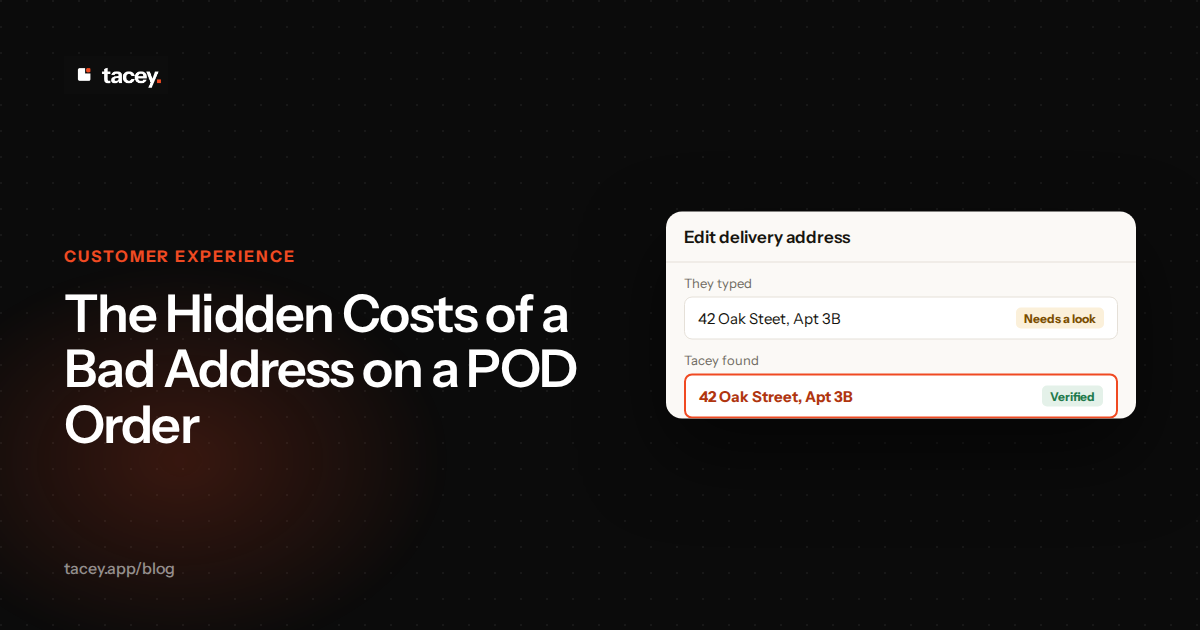
The concrete step for the customer is simple. If the app detects a likely error, a small, non-intrusive message appears on the order status page they see right after checkout. It might say, "Did you mean 123 Main Street instead of 125 Main Streat?" With one click, the customer can confirm the correction, which then updates the order in Shopify automatically.
What percentage of orders typically have address errors?
While no single statistic applies to every store, a small but meaningful percentage of orders typically contain address errors. For a POD business with thin margins, even a low rate of errors can lead to significant financial losses, as the cost of each failed delivery is high.
For a store shipping a thousand orders a month, even a low error rate means dozens of orders are at risk of failure. These failed orders could represent a substantial net loss, wiping out the profit from a large number of successful sales. The core problem is not the frequency of errors, but the high financial cost of each incident.
Because the profit margin on any single POD sale is so slim, even a low rate of failure can have an outsized impact on overall profitability. This makes managing address accuracy not just a matter of good customer service, but a core financial imperative for the health of the business.
The most reliable way to defend your store from these profit-draining errors is to catch them before they become problems. Tacey’s address validation tool automatically checks every customer address against a global database right after checkout. It runs on the order status page, adding a layer of protection without interrupting the sale.
When an issue is detected, the order can be tagged for your review, or your customer can even be prompted to fix the mistake themselves. This simple, automated check stops bad addresses from becoming lost packages, angry customers, and vanished profits. Protect your margins and improve your customer experience. Learn more about Tacey's address validation or install it today from the Shopify App Store.
Before spending another dollar on ads to acquire a new customer, consider what it costs to lose one you already have. Depending on your margins, the loss from a single failed delivery can require the profit from ten or more successful sales just to cover the deficit. The fix is often simpler and more affordable than you think, turning a major vulnerability into a reliable part of your operation.
Frequently asked questions
Will my POD supplier refund me if a package is returned?
No, a print-on-demand supplier will not issue a refund for a returned package if the delivery failed due to an error in the customer's shipping address. They fulfilled their service by printing and shipping to the address provided. The financial responsibility for customer-provided errors rests with the merchant.
Can I just fix the address myself in Shopify?
Yes, you can edit a shipping address in the Shopify admin, but this is only effective if you catch the error before the order is sent to your POD supplier. For many stores, this window is very short. A manual review process is difficult to scale and prone to missing things.
Does Tacey stop the order from shipping if the address is bad?
No, Tacey does not automatically hold or block an order from fulfillment due to a potential address issue. It flags the order by adding a tag in your Shopify admin and provides tools for you or the customer to correct the address on the post-purchase order status page. This prevents fulfillment delays while still giving you the visibility to fix errors.
Is international address validation supported?
Yes, Tacey checks addresses for orders shipping internationally, not just domestically. The system validates against official postal databases in countries around the world to help reduce delivery failures regardless of where your customer is located.
How much does address validation cost?
Address validation is a core feature included on all Tacey plans, with no extra fees. Plans are based on your store's monthly order volume and start at $29 per month for up to 750 orders, giving you access to address validation and all other order management tools.
 Install on Shopify