 tacey
 Install on Shopify

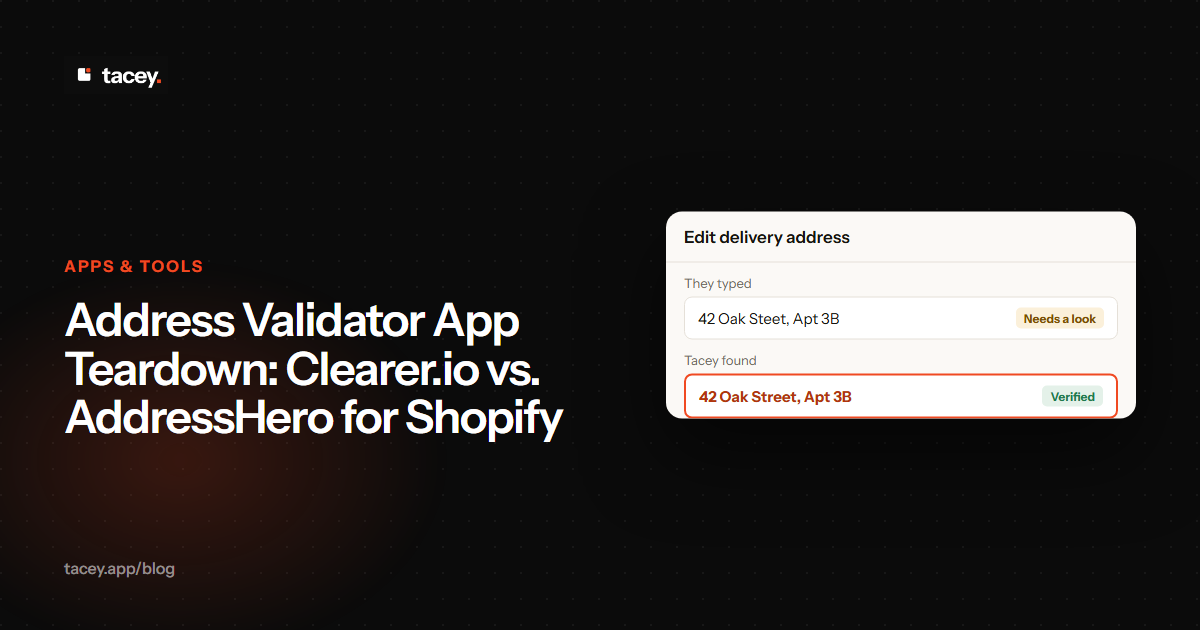
A single typo in a shipping address can cause a failed delivery. This small mistake leads to returned packages, extra shipping fees, and a frustrated customer wondering where their order is. For many Shopify stores, this isn't a rare event; it's a recurring operational cost that slowly eats into margins and customer goodwill.
While Shopify has some basic address lookup capabilities, many merchants turn to dedicated apps to catch errors before they become problems. Two of the most popular choices are Clearer.io and AddressHero. This article breaks down how they compare on features, pricing, and real merchant feedback to help you decide which is the right fit for your store.
What is a Shopify address validator app?
A Shopify address validator app checks customer-entered shipping addresses against official databases. Its goal is to catch typos, formatting errors, and missing information like an apartment number before an order is fulfilled. This helps reduce the number of packages that are returned as undeliverable.
These apps typically work by adding a small step to your store's checkout process. When a customer enters their address, the app verifies it in real-time. If it detects a potential issue, it can suggest a correction or ask the customer to confirm the details, narrowing the window for costly shipping errors.
The cost of a single failed delivery often exceeds the monthly price of a validation app. Each failed attempt involves multiple costs, including carrier fees for redelivery, the time your support team spends handling the issue, and the expense of returns processing. For an item that is not returned, the loss includes the product's cost as well. These small, recurring costs can significantly impact profitability over time.
Why Shopify's built-in validation isn't always enough
Shopify does perform some address validation, particularly when you purchase shipping labels through Shopify Shipping. It will flag addresses that it cannot verify with carriers like USPS. However, this check happens long after the customer has completed their purchase and left your site, placing the burden of correction entirely on you.
The native validation is also not a preventative measure during the ordering process itself. A customer can easily complete their purchase with a non-existent street name or a wrong zip code. You will only discover the problem when your fulfillment team tries to ship the order, leading to delays and manual follow-up work.
When an invalid address is found post-purchase, a member of your team has to stop their workflow. They must investigate the order, attempt to find a correct address using external tools, and then email the customer. This process introduces a delay of hours or even days, and every manual touchpoint is an opportunity for further error.
Let’s break down the cost of one failed delivery. The carrier charges a fee for return-to-sender shipping. A support agent has to spend time investigating the order and contacting the customer, which carries a labor cost. Then, the item must be reshipped, incurring another shipping charge. These direct costs add up quickly, before even considering the lost time in your warehouse or the potential cost of a lost product if it never returns.
Furthermore, Shopify's native tool doesn't enforce the entry of secondary address lines, like apartment or suite numbers. A customer can skip this field, resulting in an address that is technically valid but practically undeliverable. This is a common cause of failed deliveries that third-party apps are specifically designed to catch.
Introducing the contenders: Clearer.io and AddressHero
Clearer.io and AddressHero are two of the most installed address validators on the Shopify App Store. Both aim to solve the same problem but take slightly different approaches to validation, customization, and pricing. They integrate into the checkout flow to provide immediate feedback on the address a customer provides.
AddressHero focuses on a streamlined experience with automatic corrections and a simple interface. Clearer.io offers a bit more customization, allowing merchants to fine-tune how and when address suggestions appear. Both have strong reviews and serve a wide range of Shopify merchants, from small startups to larger brands.
Feature Comparison: Clearer.io vs. AddressHero
When you look closely, the differences between the two apps become clear. Both validate addresses during the checkout process, but their methods for correction, customization, and handling of international orders vary. Choosing the right one depends on how much control you want over the process and your specific customer base.
Here is how their core features stack up based on their App Store listings from October 2026.
| Feature | Clearer.io Address Validator | AddressHero |
|---|---|---|
| Validation Point | During checkout | During checkout |
| Correction Method | Suggests a corrected address in a popup | Autocompletes and corrects address fields as the user types |
| App Store Rating | 4.7 stars (196 reviews) | 4.9 stars (237 reviews) |
| Customization | Merchants can customize the popup's text, colors, and behavior | Fewer visual options; more focus on rules and automatic experience |
| Handling of Errors | Prompts customer to accept suggestion or keep original entry | Can be configured to block orders with invalid addresses |
| International Support | Yes, validates addresses globally | Yes, supports global addresses |
| Fuzzy Matching | Yes, handles common typos and misspellings | Yes, includes AI-powered typo correction |
| PO Box Blocking | Yes, can be configured with rules | Yes, available on paid plans |
The Trade-Off: Autocomplete vs. Suggestion Popup
AddressHero's primary method is autocomplete, which corrects address fields as the user types. This is fast and seamless, often fixing errors before the customer even notices. The trade-off is a loss of customer agency; some users may feel the system is overly aggressive if it changes their input unexpectedly, especially with unique or new addresses.
This trade-off can be framed as "Friction vs. Agency." AddressHero minimizes friction but reduces customer agency. This can backfire with new construction, where an address is valid but not yet in postal databases. The customer knows their address is correct, but the app disagrees, leading to frustration or abandonment if they cannot override the system easily.
Clearer.io uses a suggestion popup. After the customer enters their address, a modal appears showing the original entry alongside a suggested, standardized version. This gives the customer explicit control to choose the corrected address or keep their own. The downside is that it adds an extra click to the checkout process, a small but measurable point of friction.
To implement this, a merchant takes a concrete step: configuring the popup’s rules. In the Clearer.io dashboard, you decide the confidence threshold for when to show a suggestion. For example, you can set it to only trigger for addresses with a likely typo, ignoring minor formatting differences. This setup takes minutes but tailors the experience to your risk tolerance.
Edge Case: The Apartment Number Problem
A common failure point is a valid street address that is missing a unit or apartment number. Both apps attempt to solve this. Clearer.io, for instance, is praised by merchants for its ability to catch missing unit numbers. AddressHero allows merchants on its paid plans to block orders that are missing a house number altogether.
However, no system is perfect. If a multi-unit building is not registered as such in the postal database, the app may not know a unit number is required. In these cases, both apps allow the customer to override the suggestion and proceed, which is crucial for preventing lost sales due to a false positive.
What is Fuzzy Matching?
Both apps use "fuzzy matching" to catch typos. This technique finds matches that are similar but not identical. Instead of requiring a perfect match to a database entry, it uses algorithms to identify and correct common errors like swapped letters ("123 Mian St"), extra characters ("123 Mainn St"), or abbreviations ("123 Main St." vs "123 Main Street").
Pricing Breakdown: How much do they cost?
Both apps offer a free entry point, but their pricing models cater to different growth stages. AddressHero's plans are generally more affordable at lower order volumes, making it accessible for new stores. Clearer.io's tiers scale to support larger merchants with higher order counts.
AddressHero offers a free-to-install "Pro" plan that is usage-based at $0.04 per order, after a 14-day trial. Its "Lite" plan is $9.99/month and includes features like blocking orders missing house numbers. Clearer.io also has a free plan, and its paid tiers begin at $19.99/month, designed for businesses with more significant order volume. Your choice may come down to your current monthly order count and budget.
Worked Example: A Mid-Volume Store
Imagine a store shipping a thousand orders a month. Even a small error rate of just over one percent results in more than a dozen failed deliveries. Each failure represents a compounding loss: the return shipping fee, the support agent's time, the cost to reship, and potentially the entire cost of goods if the product is lost.
These individual costs, which can easily surpass the monthly fee of a validation app on their own, add up to a significant monthly loss. Compared to Clearer.io’s $19.99 plan or AddressHero’s $40 usage fee (1,000 * $0.04), the ROI is immediate and substantial. You are not just buying software; you are reducing a significant, recurring expense from your profit and loss statement. The investment helps prevent hundreds of dollars in losses for a fraction of the cost.
What do merchants say? App Store review analysis
Looking at reviews from October 2026, both apps are highly regarded, but for different reasons. AddressHero earns a 4.9-star rating from 237 reviews, with many users praising its simplicity and effectiveness at reducing failed deliveries "out of the box." Merchants often mention the clean dashboard and useful analytics.
A common theme for AddressHero is that it "just works," seamlessly correcting addresses without interrupting the customer. Support from the founders is also frequently highlighted as fast and helpful. The few negative comments mention occasional incorrect address replacements, particularly with some US addresses.
Clearer.io has a 4.7-star rating from 196 reviews. Its users frequently highlight the customization options and the clarity of its address suggestions. Store owners appreciate being able to match the validation popup to their brand's look and feel. The proactive and fast support team is also a recurring point of praise.
The Verdict: Which one should you choose?
There is no single best choice for every store. Your decision depends on your budget, order volume, and how much you want to customize the experience. Both apps are effective at their core job: catching bad addresses before they become costly fulfillment problems.
Pick AddressHero if: You are a new or small store that prefers a pay-as-you-go model. You want a simple, set-it-and-forget-it tool that automatically corrects addresses with minimal configuration. Its lower price point for low volumes is a significant advantage for businesses watching every dollar.
The pay-as-you-go model has an edge case to consider: high-volume sales events. During a Black Friday sale, your order count might spike from 500 to 5,000. Your validation costs would jump from $20 to $200 for that month. This variability can be tricky for budgeting if your sales are unpredictable or highly seasonal.
Pick Clearer.io if: You are a growing or established brand that values customization. You want to control the messaging and appearance of the address suggestion prompt to ensure it perfectly matches your site's branding. Its plans are built to scale with higher, more predictable order volumes.
The fixed monthly fee of a tiered plan offers budget predictability. Your finance team knows exactly what the cost will be, regardless of whether you have a slow month or a massive sales spike. This stability is often worth the higher base price for established businesses that prioritize consistent, forecastable operational expenses.
This predictability is more than just a convenience. For businesses seeking investment or applying for loans, a stable and forecastable profit and loss statement is critical. Unexpected cost spikes, even small ones, can complicate financial reporting and make a business appear less stable than it actually is. Predictable SaaS costs are easier to model.
The best tool is the one that fits the merchant's workflow, not the other way around. A solution should reduce work, not just move it somewhere else.
An alternative approach: Post-purchase validation
What if you could validate addresses without adding any friction to your checkout? Both Clearer.io and AddressHero act before payment is complete, which can sometimes interrupt a motivated buyer. An alternative is to check the address immediately *after* the order is confirmed, on the order status page.
This post-purchase approach helps ensure nothing stands in the way of a conversion. Tacey's address validation feature works this way. It checks every shipping address the moment an order is paid. If an error is found, the order is simply tagged in your Shopify admin for review. Fulfillment is never automatically blocked.
The 'Do No Harm' Principle at Checkout
The core trade-off of pre-purchase validation is conversion risk. While minimal, any extra step or script in the checkout can cause some customers to abandon their purchase. A post-purchase check avoids this risk entirely. The sale is secured first, and only then is the address verified. This prioritizes securing the revenue above all else.
When Tacey flags a bad address, the order is tagged in your Shopify admin, making it easy to spot for review. This tag doesn't hold fulfillment, so your workflow isn't interrupted. While you can always contact the customer manually for clarification, Tacey includes an automated feature specifically for this scenario called 'Pre-ship reminders'.
This automated system can send a customized email to the customer, alerting them to the potential issue and providing a direct link to their order status page. On that page, the customer can correct their own shipping details before the order ships. This self-service approach reduces support tickets and resolves errors without manual intervention from your team.
This combination gives you full control over communication. You can rely on the automated reminders or handle exceptions manually. Because this capability is part of a broader order editing toolset, it empowers the customer to solve the problem themselves, improving their experience and securing the sale. All Tacey plans include this feature, with pricing based on order volume.
Ultimately, preventing failed deliveries is about creating a process that catches errors efficiently. Whether you choose a checkout validator like Clearer.io or AddressHero, or a post-purchase tool, the goal is the same: to get the right product to the right address on the first try. A small investment here saves significant time and money down the line.
Frequently asked questions
Do these address validator apps work for international orders?
Yes, both Clearer.io and AddressHero offer validation for international addresses. They check against global address databases to help ensure accuracy for customers around the world, which is crucial for stores with a global market.
Can I block deliveries to PO Boxes?
Some address validation apps, including AddressHero and Clearer.io, allow you to create custom rules to block certain address types, like PO Boxes or military addresses (APO/FPO). This is a useful feature if your shipping carriers have restrictions.
What is the difference between address validation and address verification?
Validation generally refers to checking if an address is formatted correctly and exists in a postal database. Verification can sometimes go a step further to confirm that a specific person or business resides at that address. For most Shopify stores, validation is the key function needed to prevent delivery errors.
Will an address validator slow down my checkout?
These apps are designed to be lightweight and fast. However, any third-party script added to the checkout can have a minor impact. Both Clearer.io and AddressHero are optimized to run quickly to minimize any potential delay for the customer, and merchant reviews suggest no noticeable impact on conversion.
What happens if the customer's address is correct but the app says it's wrong?
This is a known edge case. Both apps allow the customer to override the suggestion and proceed with the address they originally entered. This helps ensure that a false positive from the validator does not prevent a legitimate sale.
Can I install these apps on any Shopify plan?
Yes, address validation apps that integrate with the checkout are available for all Shopify plans, not just Shopify Plus. This makes them accessible to stores of all sizes looking to reduce shipping errors.
 Install on Shopify