 tacey
tacey Install on Shopify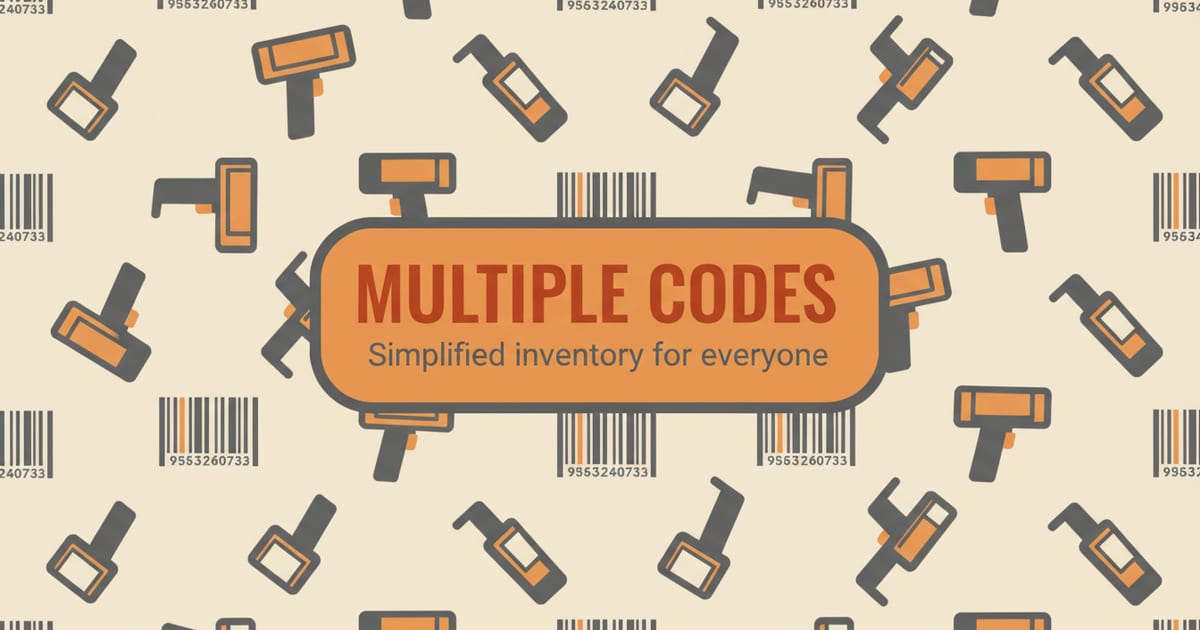
A small but significant change to the Shopify platform has resolved a long-standing operational headache for merchants. As of September 2026, a single product variant can now hold up to twenty different barcodes. This seemingly minor update to the product data model is a foundational fix for a category of problems that has complicated inventory management and point-of-sale operations for years, particularly for businesses that source from multiple suppliers or sell across multiple channels.
Previously, a Shopify variant had a single field for a barcode. This forced merchants to choose just one identifier for an item that might have several in reality: the manufacturer's UPC on the box, a private-label EAN for internal tracking, an ASIN for an Amazon listing, or a GTIN from a supplier. The other codes were relegated to spreadsheets or metafields, disconnected from the core product record and invisible to most apps and scanners. Now, any of those identifiers can be attached directly to the variant, and any of them can be used to find the product.
This guide explains what this change means for merchants, how to implement it in your store, and the impact it has on inventory, fulfillment, and multi-channel sales. It is a piece of platform plumbing that, once understood, can eliminate a surprising amount of manual work and day-to-day friction.
The Problem One Barcode Created
The limitation of a single barcode field forced a difficult choice: which identifier is the "real" one? A warehouse picker scanning a carton from a new supplier might find their scanner returns no product, not because the item is wrong, but because the barcode on the box is not the one entered in Shopify. This single point of failure created persistent issues in receiving, picking, and at the retail counter.
Consider a common scenario for a growing brand. You might start by sourcing a product from a manufacturer that uses a standard 12-digit UPC, a type of Global Trade Item Number (GTIN). As your business grows, you decide to create your own private-label packaging with a different barcode, perhaps a 13-digit EAN, to control your branding. Now the same physical item has two valid identifiers. If you also sell that product on Amazon, it will have an ASIN as well. With only one field, two of those three codes had to live outside the primary product data.
This created operational drift. The warehouse team might have a printed lookup sheet taped to a wall, translating supplier codes to internal ones. A retail associate might have to manually search for a product by name when a scan fails, slowing down the checkout line. These small moments of friction add up, introducing opportunities for human error and consuming staff time that could be better spent elsewhere. The cost of this inefficiency is not trivial. Each failed scan forces an employee to stop, break their workflow, and perform a manual search. While each instance might only last for a fraction of a minute, these interruptions compound significantly over thousands of scans per month across receiving, picking, and point-of-sale. The cumulative effect is hours of paid labor spent not on productive work, but on waiting for a system that cannot recognize its own products. This represents a direct and recurring drain on the business's payroll, turning a simple data limitation into a tangible operating expense.
The financial impact escalates dramatically when barcode ambiguity leads not just to delays, but to outright errors. Imagine a warehouse picker, faced with two visually similar products from different suppliers, scans the one barcode Shopify recognizes but picks the other item. The wrong product is shipped. This single mistake now triggers a cascade of costs. A customer support ticket is created, consuming valuable agent time. The business must then pay for return shipping for the incorrect item, absorb the cost of the product itself if it cannot be resold, and pay for shipping the correct item a second time. A single error rooted in a data model limitation has now incurred multiple hard costs, eroded customer trust, and risked a negative public review, a far greater price than a few seconds of lost productivity.
The problem was especially acute for businesses with complex sourcing. A dropshipper might receive the same product from three different suppliers, each with their own unique barcode. A retailer might get a shipment where the case has one barcode but the individual items inside have another. Before this update, the only solution was to create duplicate product variants, which polluted the catalog and complicated inventory tracking, or to rely on third-party apps and external databases to manage the mapping. These workarounds added cost and complexity, all to solve a problem that stemmed from a single data field.
How Multiple Barcodes Fix the Mismatch
The September 2026 update directly addresses this by turning the single `barcode` field into a collection. A product variant can now have a list of up to 20 associated barcodes, each with a designated type. This allows the Shopify product record to finally serve as a single source of truth for all the ways an item is identified in the real world. The immediate benefit is flexibility and a reduction in scanning errors.
When a warehouse worker scans a product, the system can now check against the entire list of associated codes. The manufacturer's UPC, the private-label EAN, and a custom internal code can all coexist on the same variant. If any of them are scanned, Shopify POS and the mobile app will correctly identify the product. This eliminates the need for manual lookups and external translation tables, streamlining workflows from inventory receiving to retail checkout. This is particularly valuable during stocktakes, where items from different sourcing batches, each with a different supplier barcode, can now be scanned accurately without causing exceptions, dramatically increasing both the speed and accuracy of cycle counts.
Shopify allows merchants to specify the type for each barcode: UPC, EAN, ISBN (for books), GTIN, or ASIN. This is more than just a label; the system validates the entry against the format of that standard. For instance, it will check that a UPC has the correct number of digits and a valid structure, and that an ISBN-13 has a valid check digit. This simple validation at the point of data entry helps catch typos and formatting errors before they become a problem in the warehouse or with a sales channel feed. A "Custom" type is also available for internal codes that do not adhere to a global standard, giving merchants the flexibility to integrate their own internal SKU systems or supplier-specific part numbers directly onto the variant record.
For merchants already using barcodes, Shopify has ensured backward compatibility. The original `barcode` field still exists and will always return the first barcode in the new list. This means existing apps and integrations will continue to function, but it introduces a strategic choice known as the "Legacy Sync Trade-off." Maintaining this compatibility means older systems are blind to the new identifiers. For example, if your third-party logistics (3PL) partner’s system has not been updated, it will only ever see that first barcode. If they receive a shipment from your supplier with a different, valid barcode from your list, their system will flag it as an unknown product, rejecting the shipment and creating a costly logistical snarl. The burden is on you to either pressure your partner to update their integration, find a new partner who has, or strategically limit your own use of the new feature to avoid breaking your fulfillment workflow.
Putting It Into Practice: A Merchant's Workflow
Adopting the new multi-barcode system is straightforward. Merchants can add, edit, and remove barcodes directly on the variant details page in the Shopify admin or through the mobile app. The interface now allows for adding multiple entries, each with its own type and value. This is the most direct way to handle one-off additions, such as when a new supplier's code needs to be added to an existing product.
For larger-scale updates, the platform provides two powerful tools: the bulk editor and CSV import/export. The bulk editor lets you add or modify barcodes across many variants at once, which is ideal for applying a new set of internal codes to an entire product line. For a complete overhaul or migrating data from an external spreadsheet, the product CSV file now includes a `Variant Barcodes` column. You can export your products, populate this column with all relevant codes for each variant, separating multiple barcodes with a semicolon, and import the file back into Shopify. Crucially, you must select the "Overwrite products with matching handles" option on import for the changes to take effect on existing products.
This CSV method is the most powerful path for a merchant with a mature but messy data system. Consider a store with 800 variants that has been managing supplier codes in a separate Google Sheet for years. Instead of a multi-week manual data entry project, the workflow becomes a few hours of spreadsheet work. After exporting the product CSV from Shopify, the merchant can use a `VLOOKUP` or `INDEX/MATCH` function to pull the supplier barcodes from their master sheet into the new `Variant Barcodes` column of the Shopify export, placing them after the existing primary barcode and a semicolon. For example, a cell might go from `123456789012` to `123456789012; 987654321098`. After carefully checking for formatting errors like extra spaces, the prepared CSV is imported, and in minutes, the entire product catalog is enriched with years of accumulated supplier data, immediately making it scannable and searchable within Shopify.
A crucial part of the new workflow is the improved search capability. The product search and filtering tools within the Shopify admin now check against all associated barcodes. This makes it much easier to find products, regardless of which identifier you have on hand. This same logic extends to the Shopify POS system, where staff can scan any of a variant's barcodes to pull up the correct item during checkout or while performing inventory counts. A bookseller, for example, can now store both the old ISBN-10 and the current ISBN-13 for a title on one variant. When a customer brings a used copy with the older code to the counter, a scan will now correctly find the product, whereas before it would have resulted in a frustrating "product not found" error, improving both efficiency and the customer experience.
While the feature is powerful, it requires a clear data strategy. It is important to define which barcode should be "first" in the list, as this is the one that will be used by older integrations and sales channel feeds that have not yet been updated. Generally, this should be the primary barcode used for your own branding and packaging. The cost of getting this wrong can be significant; if a generic supplier GTIN is placed first, your Google Shopping feed might use that identifier, causing your product to be grouped with competitor listings or lose its specific brand identity in search results. Other identifiers, like those from suppliers or specific marketplaces, can then be added to the list in any order. A consistent approach prevents unexpected behavior in connected systems.
Broader Implications for Inventory and Channel Management
While the most immediate benefits are in warehouse and POS scanning, the ability to store multiple identifiers on a single variant has wider implications for the business. It fundamentally cleans up product data, which in turn simplifies integrations with external systems like Enterprise Resource Planning (ERP) or Product Information Management (PIM) software. These systems often need to map multiple identifiers to a single master SKU, a process that is now natively supported within Shopify. An integration with an ERP like NetSuite, for example, previously required a separate middleware mapping table to reconcile Shopify SKUs with internal part numbers and supplier codes. Now, the integration can push an array of identifiers directly to the Shopify variant, reducing complexity and the frequent sync errors that plagued such setups.
This shift away from middleware is significant. That mapping layer, often a custom-built script or a paid third-party service, represents a constant point of failure. A minor API change from either Shopify or the ERP could break the connection, leading to hours of costly developer time to diagnose and fix the issue. During that downtime, inventory levels would diverge between the systems. This creates a high risk of overselling popular products to disappointed customers or, conversely, showing items as out of stock when the warehouse is full, resulting in lost sales. Removing the middleware eliminates this entire category of risk.
Multi-channel selling becomes more resilient. If you sell the same product on your Shopify store, Amazon, and a wholesale portal, you can now store the Shopify-internal barcode, the Amazon ASIN, and the wholesale GTIN on the same variant record. This reduces the risk of sales channels falling out of sync and simplifies inventory reconciliation. When an order comes in from any channel, the identifier can be traced back to the correct Shopify variant, ensuring inventory levels are updated accurately across the board. This is a critical improvement for preventing overselling, as it closes a common loophole where sales from a channel using a secondary identifier would not decrement inventory from the master Shopify record until a manual or delayed sync occurred.
This update also prepares a store for more advanced inventory management techniques. For example, some merchants may source the same product from different suppliers at different costs. While Shopify does not yet support multi-supplier tracking on a single variant, having the unique supplier barcodes associated with the product is a necessary first step. It builds a data foundation that could support more granular inventory tracking and cost of goods sold (COGS) analysis in the future. By associating each supplier's unique barcode with the product now, merchants are future-proofing their catalog for eventual platform features or app solutions that could use this data for supplier-level performance reporting or landed cost calculation.
However, it is important for developers and merchants with custom integrations to be aware of the technical changes. Shopify has marked the old, singular `barcode` field as deprecated and encourages developers to update their code. An edge case that breaks the standard "just update it" advice is a business-critical but unmaintained app. Consider a merchant who relies on a custom-built label printing solution from a now-defunct developer, an app that is essential for their specific packaging workflow. This app reads the old `barcode` field to generate its labels. If the merchant adds new supplier barcodes, the app remains oblivious. But if they reorder their barcodes to make a new EAN primary, the app will suddenly start printing the wrong codes, breaking their process. They face a painful choice: either forgo using the new barcode feature to its full potential, or commission a costly rebuild of the app from scratch, a project that could represent a significant and unplanned expense for even a simple utility.
The best platform improvements are the ones that remove invisible friction. When a system of record doesn't match the physical world, teams are forced to invent workarounds. A small change that makes the data model more honest, like this one, can delete an entire category of those daily patches and manual fixes.
What This Update Doesn't Change
While the multi-barcode feature is a significant step forward, it is important to understand its limitations. The feature is designed to associate multiple identifiers with the *same sellable item*. It is not a tool for bundling different products or managing variations that should be distinct SKUs. For example, a red shirt and a blue shirt are separate variants and should have their own unique primary barcodes, even if they share some supplier codes. Using the multi-barcode feature to group them would break inventory tracking. Each distinct sellable item requires its own unique primary GTIN, a rule enforced by GS1 and expected by all major retail channels.
The update also does not change how sales channels fundamentally work. Most channels, like Google Shopping or Facebook, will still only ingest the first barcode provided in the product feed. This reinforces the importance of deciding which barcode will be the primary identifier and placing it first in the list for each variant. If a generic supplier GTIN is accidentally placed first for a private-label product, for example, your Google Shopping listing may be merged with dozens of other retailers selling a visually similar item. Instead of owning the buy box for your branded product, you are now just one name in a list, forced into a price war that erodes your margins and brand equity. The additional barcodes are primarily for internal operational efficiency and for systems that are specifically designed to look for them, like Shopify POS. Thinking the system will automatically provide the correct barcode to the correct channel is a mistake; the logic is simply "first one wins, " making the ordering of the barcode list a critical data governance task for the merchant.
Furthermore, this feature does not create barcodes for you. Merchants are still responsible for obtaining valid GTINs (like UPCs and EANs) from a standards organization like GS1 for products that require them. This involves a real financial commitment, as licensing a company prefix from GS1 requires a significant initial investment and ongoing annual renewal fees to keep the codes active. While tempting to buy cheaper codes from online resellers, this is a risky practice. These are often recycled UPCs that can create major conflicts on marketplaces like Amazon, where your new product could suddenly be identified as someone else's discontinued item from a decade ago, leading to delistings and a brand reputation nightmare. The small amount saved is not worth the risk of having thousands of dollars of inventory frozen in an FBA warehouse because of a barcode collision.
Finally, data entry discipline is paramount, as an incorrect setup can cause more harm than the single-barcode limitation ever did. A concrete example of failure is in case-pack receiving. Say you sell single energy drinks (with UPC `A`) and cases of 24 (with UPC `B`), which must be two separate variants with different prices and weights. If a warehouse worker receives a pallet of 50 cases and scans the case's UPC `B`, but you have incorrectly assigned that barcode to the single-drink variant, the system will receive 50 individual drinks instead of 50 cases (which contain 1,200 drinks). Your inventory system now shows 50 units in stock and will stop accepting orders after the 50th sale. In reality, you have 1,150 units left, but they have become dead stock, invisible to your storefront.
The inverse error is even more damaging. If you assign the single-drink UPC `A` to the case variant, a scan of a single can is misinterpreted as a full case. The system now thinks it has far more stock than it does, leading to widespread overselling. This results in a wave of failed orders and a customer service crisis that can permanently damage your store's reputation. The feature's power requires precision; a small data entry mistake can create large-scale operational problems.
Ultimately, Shopify's support for multiple barcodes is a foundational improvement that acknowledges the complexities of modern retail and supply chains. It replaces messy workarounds with a clean, native solution built directly into the product catalog. For any merchant who has ever dealt with the frustration of a failed scan or managed a spreadsheet of competing product codes, this update provides a clear path to simplifying operations and building a more resilient inventory system. It is a quiet change, but one that will have a lasting, positive impact on day-to-day efficiency. This focus on operational resilience is key, as it also underpins tools that give customers self-service options, like the ability to edit their own orders before they ship.
 Install on Shopify