 tacey
 Install on Shopify

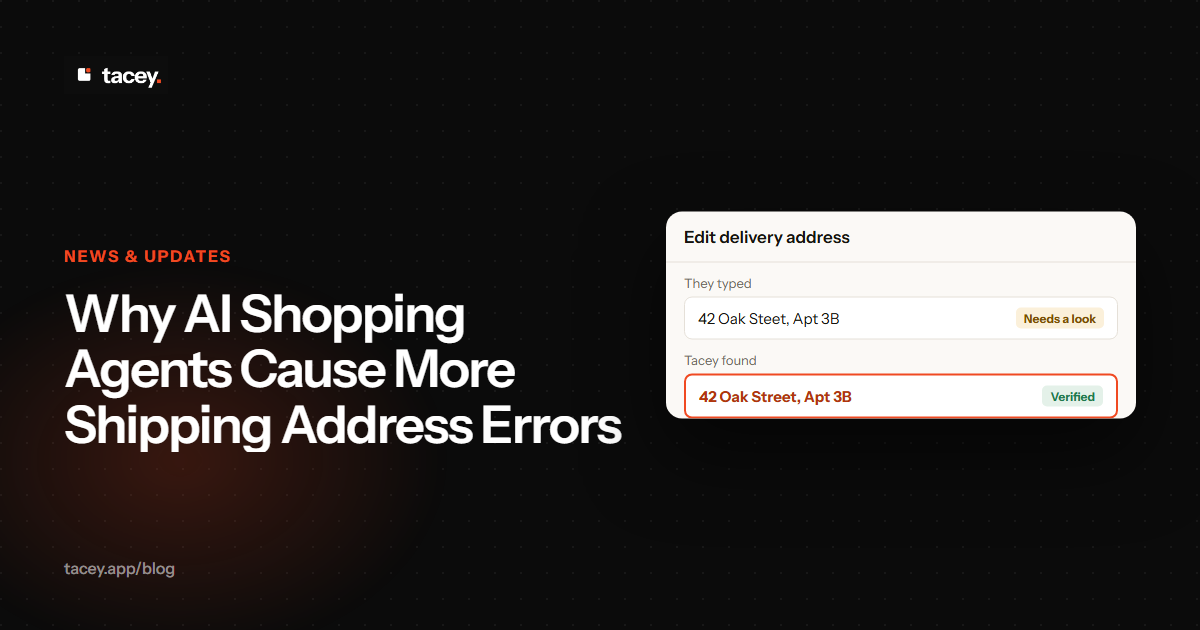
A new class of software is placing orders on Shopify, and it’s making a specific and expensive type of mistake. As AI-powered agentic commerce becomes a more significant part of the online shopping landscape, merchants are seeing a quiet increase in a problem they thought they had solved: the wrong shipping address. These are not simple typos, but subtle errors of context and interpretation that cause failed deliveries and frustrate customers.
Unlike a human shopper, an AI agent might misinterpret a casual instruction or pull outdated information from a connected account. The result is an order that looks correct but is fundamentally undeliverable. For Shopify merchants, this trend represents a new operational challenge that requires a shift in how they think about order verification.
What is agentic commerce?
Agentic commerce is the use of AI agents to autonomously research, select, and purchase products on behalf of a human user. Instead of browsing a store, the user gives the agent a goal, like "buy the same coffee beans I ordered last month, but find a better price." The agent then navigates websites, compares options, and completes the transaction.
This technology is moving from theory to practice. As major platforms integrate these capabilities, agent-assisted spending is poised to become a more common part of the ecommerce landscape. Major platforms are integrating these capabilities, meaning merchants will increasingly receive orders placed not by a person at a keyboard, but by a piece of software executing a command.
From Voice Commands to Autonomous Buyers
These agents exist on a spectrum. Simple versions are already common, like asking a voice assistant to reorder a product. More advanced agents operate as browser extensions, filling forms and applying discount codes. The most sophisticated are fully autonomous, capable of complex research and negotiation without direct human oversight.
The critical link is the data these agents access. They connect to a user's digital life, their calendar, contact list, email, and past order history. The agent’s goal is to use this context to make intelligent purchasing decisions. However, this same data can become a source of profound and expensive errors when it is incomplete or out of date.
An agent builds a "data mosaic" of the user, piecing together information from many disconnected sources. The shipping address might come from a contacts app, the payment method from a password manager, and the product choice from an old email receipt. If any piece of this mosaic is flawed, the entire order is compromised, often in ways that are hard to detect.
This shift introduces a new layer of abstraction between the store and the end customer. The "buyer" in this scenario is a program, and it doesn't think or behave like a human customer. This distinction is the root cause of many new fulfillment issues.
Why do AI agents generate more address errors?
AI agents make more address errors because they often lack the real-world context a human has. They are prone to specific failure modes, including misinterpreting instructions, using outdated autofill data, and struggling with non-standard address formats, all of which can result in costly failed deliveries.
The "Old Work Address" Edge Case
Consider a concrete example. A user tells their agent, "Ship my usual moisturizer to the office, I'm running low." The agent correctly identifies the product. It then queries the user's contact card for an address labeled "Work." It finds one and places the order. The problem? The user changed jobs six months ago. The address is for a company they no longer work for.
The address itself is perfectly valid. It passes a standard database check. But it is contextually wrong for this order. The package is now headed to a commercial building where the recipient is unknown. It will be refused at the front desk and returned to the sender, but only after incurring multiple fees and several days of delay.
An agent might correctly execute a command to "ship to my work address" but pull a former employer's location from a user's contact card. It might fail to include a necessary apartment or suite number because the data source it used was incomplete. These are not typos a simple validator would catch; they are errors of logic and data interpretation.
The Ambiguity of "Home"
Another common failure mode involves ambiguous locations. A user with a primary residence and a weekend cabin might tell their agent, "Send my next subscription box home." The agent, lacking immediate context, defaults to the primary address on file. The user, however, is at the cabin for the week and expected it to arrive there.
This isn't a data error; it's a context error. The agent executed the command literally, without the human ability to ask, "Which home do you mean?" The package is now sitting on a porch hundreds of miles away. The merchant has fulfilled the order correctly, but the customer's experience is a failure, and a replacement shipment is often required.
Furthermore, these agents can operate in a legal gray area, sometimes masking their identity to comply with a site's terms of service. This can lead them to bypass standard checkout validation steps, submitting an order with flawed data that a human would have been prompted to correct.
The Missing Data Fragment
A third failure mode is the partially complete address. An agent might have a valid street, city, and postal code, but be missing a critical piece of information like an apartment number or a building access code. The address will pass validation, but the physical delivery will fail. The carrier cannot complete the final step.
This happens when the agent's data source never required that extra detail. A user's primary contact card might not store their suite number, for example. The agent, focused on executing its task, has no basis to ask for the missing information. It submits the order with the incomplete, but technically valid, address.
How do these errors impact Shopify merchants?
An incorrect address is one of the most expensive errors in ecommerce. Each failed delivery incurs direct costs, such as significant carrier surcharges for address correction, return shipping fees, and the cost of reshipping the item. When combined, the total cost of a single failed delivery can easily erase the profit on an order.
Calculating the True Cost of a Single Error
Let's trace the cascading costs of one agent-generated mistake. First, there is the initial, unrecoverable cost of shipping the product to the wrong address. When the carrier fails to deliver, they often apply a substantial address correction or return-to-sender surcharge, a penalty that can be several times the original shipping cost. Then, the merchant pays for return shipping to get the package back to the warehouse.
Once the customer reports the issue, support staff must spend paid time investigating the problem and communicating with the customer. Finally, to resolve the issue, the merchant has to ship the product a second time, paying for postage again. These multiple, compounding charges can easily accumulate to a total that exceeds the original value of the product, turning a profitable sale into a significant loss. And this financial hit doesn't even account for the possibility of the returned product being damaged and unsellable.
The indirect costs are even higher. A failed delivery is a primary driver of customer dissatisfaction, leading to negative reviews, increased support tickets, and lost customer loyalty. A poor delivery experience erodes trust, and a customer who feels let down is far less likely to make a future purchase, which directly damages long-term customer lifetime value.
This single error also has operational ripple effects. The returned item must be inspected, repackaged, and restocked, which takes warehouse staff time. For that period, it was "phantom inventory"-unavailable for sale but still occupying a stock location. If it was the last unit, your product page may have falsely shown "sold out, " costing you other potential sales.
This phantom inventory skews your data. Your inventory management system shows one unit tied to an in-transit order, but it is actually on its way back. This miscalculation can affect your demand forecasting and reordering triggers. If you rely on automated purchasing, you might under-order popular products, leading to preventable stockouts.
Can't traditional address validation fix this?
Traditional address validation, which typically runs during checkout, is not sufficient to catch many AI-generated errors. These tools are designed to correct typos, standardize formats, and confirm that an address exists in a postal database. They are less effective at identifying an address that is valid but contextually wrong for the order.
The Limits of Database Matching
A standard address validator is a powerful tool for fixing common human errors. If a customer types "123 Main Stret, " the validator suggests "123 Main Street." It ensures the city, state, and ZIP code align with postal records. This process, often called CASS certification in the US, prevents many undeliverable packages due to simple mistakes.
The problem is that AI agents don't make typos. They make logical errors. An agent might pull a real, valid address from the wrong source, like using a billing address for shipping. The validator confirms "123 Main St, Anytown" is a real place, and the order goes through. It has no way of knowing the customer actually lives at "456 Oak Ave."
The "Good Enough" Address Problem
This highlights a critical trade-off. Checkout validation tools are designed to reduce friction, not to be perfect. They answer the question, "Can a postal carrier find this location?" not "Is this the location the customer intended?" As long as the address is "good enough" to exist in a database, it passes, pushing the risk of a contextual error downstream to the fulfillment team.
This exposes a classic ecommerce dilemma: the Friction-Accuracy Trade-off. Merchants know that every extra field or validation step at checkout slightly increases the risk of cart abandonment. To maximize conversion, they accept addresses that are plausible but not perfect. This pushes the problem, and the cost, onto the fulfillment and support teams.
Because agents can compress the buying process into a nearly instantaneous transaction, they can bypass the moments of human review where such errors are often caught. The order is paid for and confirmed before anyone realizes the mistake.
How can merchants mitigate agentic commerce address errors?
The most effective strategy is to validate addresses after the order is placed but before it is sent to fulfillment. This post-purchase window provides a critical opportunity to review and flag potentially problematic orders without adding friction to the checkout process or risking the sale.
Building a Post-Purchase Review Workflow
A concrete first step is to create a dedicated process. Use a Shopify Flow or a third-party app to automatically add a tag like "Address Review Needed" to orders that meet certain risk criteria. For example, set a trigger for when an order is created, then add a condition to check if the shipping address contains a company name but the customer is not tagged as B2B.
Next, create a saved view in your Shopify Orders list that shows only orders with this tag. Assign a specific team member to check this view at the start of each day before any fulfillment batches are run. Their job is to quickly vet these addresses. They can use Google Street View or contact the customer if needed.
Equip your team with a simple template for outreach. An email saying, "Hi [Customer Name], we're preparing your order. We just want to confirm the shipping address at [Company Name]. Is that correct, and is there a suite or floor number we should add?" This proactive check takes seconds but can prevent a costly delivery failure.
The return on this manual effort is immediate. If a team member spends a small portion of their day reviewing flagged orders, the labor cost is minimal. Because the combined costs of a single failed delivery, with its carrier surcharges, return fees, and reshipping expenses, are so high, preventing just one such error can often pay for the entire review process for that day, making the workflow instantly profitable. It is a small investment of time that yields a significant financial return.
This simple workflow creates a crucial human checkpoint. It re-introduces the context and world knowledge that an AI agent lacks. It turns an abstract problem into a manageable daily task, preventing expensive shipping errors before they leave the warehouse. It is a concrete action you can take this afternoon.
This approach allows the merchant to contact the customer or have the customer self-correct the issue on the order status page. It narrows the window for error, turning a potential failed delivery into a simple data correction.
The goal isn't to stop automation, it's to give the operator control at the critical moment. An AI can place the order, but the merchant needs the final say before a box leaves the warehouse.
A strategy for the agentic era
Tacey provides a robust post-purchase address validation system designed for the realities of modern commerce. Immediately after an order is paid for, Tacey checks the shipping address against professional address data. It flags any order with a potential issue directly in the Shopify admin, giving the merchant a chance to review it before it ships.
This system provides a crucial safety net where traditional checkout validators can fall short. While a standard check confirms an address exists, Tacey's post-purchase check flags any order with potential discrepancies against professional address data. This tag creates a vital opportunity for a merchant to review the order, helping them catch issues like incomplete addresses or formatting that deviates from postal service records before the package ships and a costly error occurs.
Crucially, a potential address issue flagged by Tacey does not automatically block or hold fulfillment. It provides the merchant with the necessary information to make a decision, maintaining operator control. For a flat monthly fee based on order volume, stores can significantly reduce the costs and customer service headaches associated with wrong addresses. You can review the plans on our pricing page.
As AI agents become more common, the frequency of subtle, hard-to-detect address errors is likely to increase. A proactive, post-purchase validation strategy is no longer just a best practice; it is essential for protecting your margins in the age of agentic commerce.
Frequently asked questions
What is an AI shopping agent?
An AI shopping agent is a software program that uses artificial intelligence to make purchases on behalf of a person. The user gives it instructions, and the agent finds products, compares prices, and completes the checkout process autonomously.
Why does agentic commerce cause more shipping errors?
Agentic commerce can lead to more shipping errors because AI agents may misinterpret user commands, use outdated personal information like old addresses, or fail to handle complex address details like apartment numbers correctly.
What is the cost of a failed delivery?
A single failed delivery can cost a merchant significantly. Carrier surcharges for address correction alone can be substantial. When you add reshipping, support time, and potential inventory loss, the total direct cost can easily exceed the value of the order itself, not including the potential loss of the customer.
How is post-purchase validation different from checkout validation?
Checkout validation happens before payment and aims to correct typos in real-time. Post-purchase validation happens after payment but before fulfillment, providing a safety net to review potentially incorrect addresses without risking the sale.
Will AI agents get smarter and stop making these mistakes?
While the AI models will improve, many errors stem from outdated or ambiguous user data, not the agent's intelligence. As long as people change jobs, move houses, and give vague commands, the underlying risk of contextual address errors will persist. The problem is often the data, not the agent itself.
Can a customer fix their own address error?
Yes, with tools like Tacey, merchants can empower customers to correct their own shipping address on the order status page. This self-service capability reduces support tickets and resolves issues quickly.
Is agentic commerce a major part of ecommerce now?
While still emerging, agentic commerce is growing. Major technology companies are investing in this area, making it a significant trend for merchants to watch.
 Install on Shopify